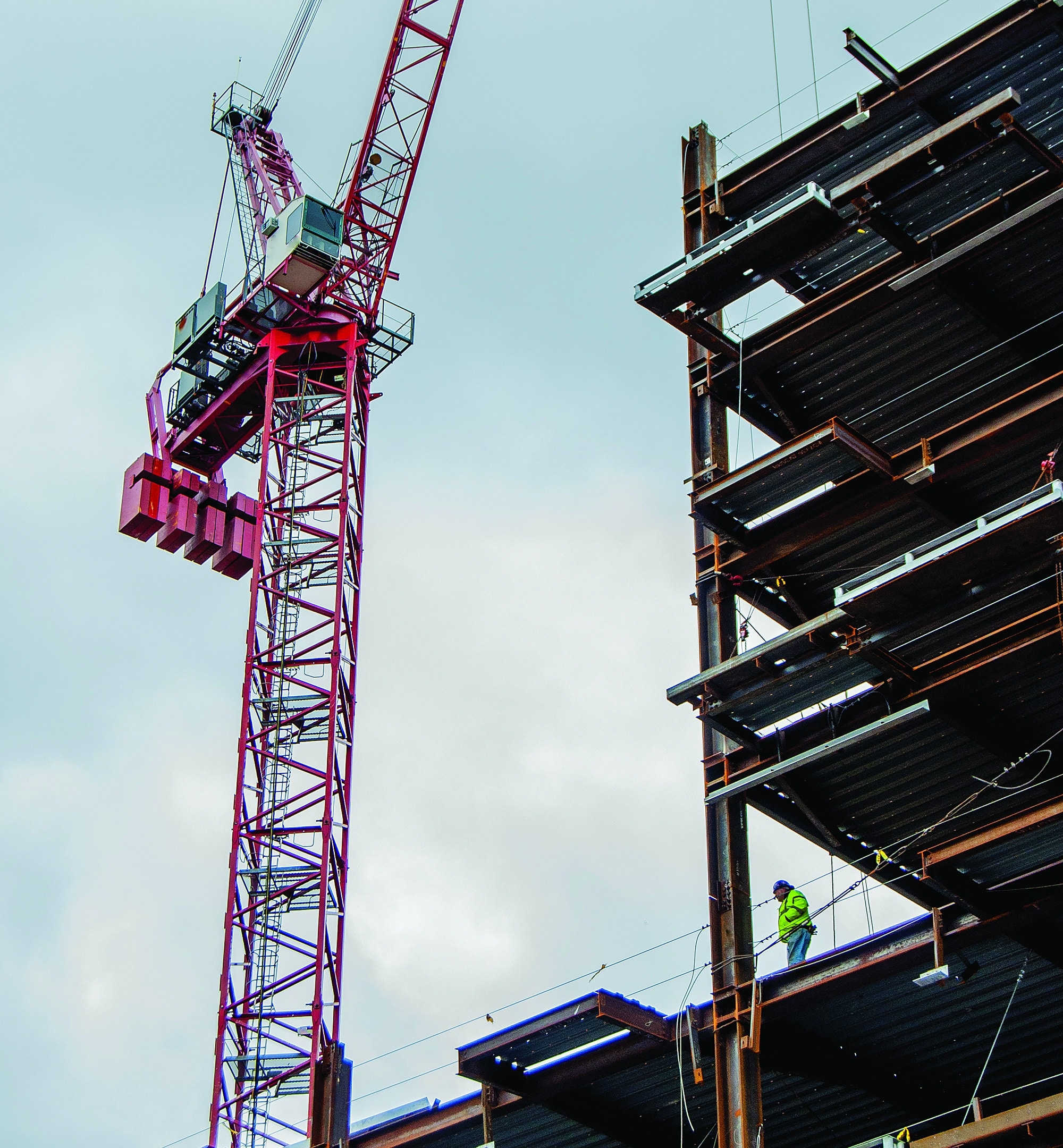
Very few of the buildings that broke ground in Boston this year are for office or institutional uses.
Boston is still in the midst of an epic building boom. No one in their right mind disputes that.
But as the pandemic rolls on, warning signs have emerged that could spell trouble down the line for a city that depends heavily on new commercial development to fill its tax coffers.
Former Mayor Marty Walsh made headlines last year when the city became the first major metropolis in the country to shut down all but essential construction for several weeks last spring as the first wave of COVID-19 hit.
Given that backdrop, it would then seem logical that we’d see a robust rebound in new construction starts during the first half of this year.
But just the opposite has happened.
One-Tenth the Activity
Construction starts on new office and institutional buildings in Boston have plunged in the first half of 2021 compared to the same period in 2020, according to the Boston Planning & Development Agency.
So far this year, builders have broken ground on just under 354,000 square feet of new office and institutional space.
That’s roughly one-tenth of the 3.4 million square feet of commercial space that developers kicked off construction on during the first half of COVID-plagued 2020.
And while overall construction activity in the city, from projects that started in previous years, remains at a record level, it has also fallen steeply from last year.
The amount of new space under construction – from commercial projects to apartments to hospital buildings – has dropped by roughly a quarter from last year, from roughly 14.7 million square feet to 11.5 million.
“To the extent it comes up, it’s all about waiting for some stability in the market,” BPDA Director Brian Golden said of his talks with commercial developers. “We remain in a wait-and-see mode.”
So, what gives?
Tenants, Developers Watch and Wait
One obvious answer is that developers of new office towers are taking a breather and waiting to see how demand for corporate space shakes out in the wake of the coronavirus.
Companies are finding they are likely to need less space as before, embracing work-from-home – for at least part of the workweek – in a way they never had before for large numbers of their employees.
The businesses large and small that drive the office market naturally see the potential to spend less money spent on overhead costs like rent, while also cutting down on time-consuming, productivity-sapping commutes.
Corporate America could wind up shrinking its office footprint by as much as 20 percent, noted Golden, citing a recent talk given to BPDA staff by a Harvard University expert.
Meanwhile, other office developers are going back to the drawing boards.
Instead of breaking ground this year, as they had planned, on new office buildings, some are looking to revamp their plans and restart their projects as lab space, which is in high demand right now across the Boston area.

If sinking office demand sends Boston office tower values tumbling, the city budget – funded largely by property taxes on these buildings – will be in trouble.
A Slump May Not Be Bad News
Golden remains sanguine about the numbers. Boston has been pumping out roughly 10 million square feet of new commercial and residential space each year over the last seven years.
That’s far higher than any other similar period in city history.
And despite the drop, this year looks like another banner one for new construction as well, given that work is underway on 11.7 million square feet right now.
There’s also been a big jump in developers filing plans for new projects.
The BPDA has fielded 20 different project notification forms so far this year, compared to 14 during the first six months of 2019, in pre-pandemic times.
Nor is the BPDA chief ready to push the panic button on the drop in new office construction, even though “lion’s share” of projects pitched this year are for life sciences uses, Golden said, with few if any new office plans.
“Life science have come to roaring to life in the wake of the pandemic,” he said. “It’s been on fire.”
Certainly, if companies do slash their office footprints by 15 to 20 percent, that could be a tough pill for office tower owners to swallow, likely forcing them into rent cut to fill that empty space.
But it won’t necessarily be a terrible thing in the long run for the market or the city, opening the door for smaller, more innovative firms to move into office space they wouldn’t have been able to afford before, Golden said.
“You won’t see those buildings implode – you will see new entrants into the market,” he said.
A Reason to Worry
Yet it’s also probably safe to say that behind the brave words, there is only naturally going to be some uneasiness somewhere in City Hall.
There are no crystal balls or guarantees that everything will work out as conveniently as Golden predicts when it comes to the big freeze in new office construction.

Scott Van Voorhis
What’s to say that companies won’t scale back their office footprints by even bigger numbers, ditching not 15 or 20 percent, but 30 or 40 percent?
And what if a big part of that empty space doesn’t get filled? Long-term vacancies drive down the value of the office towers, and Boston depends on the property taxes paid by those towers to pay its bills.
New office construction right now is practically nonexistent for some very solid reasons. And until things steady out, there will be ample cause for concern.
Scott Van Voorhis is Banker & Tradesman’s columnist; opinions expressed are his own. He may be reached at sbvanvoorhis@hotmail.com.