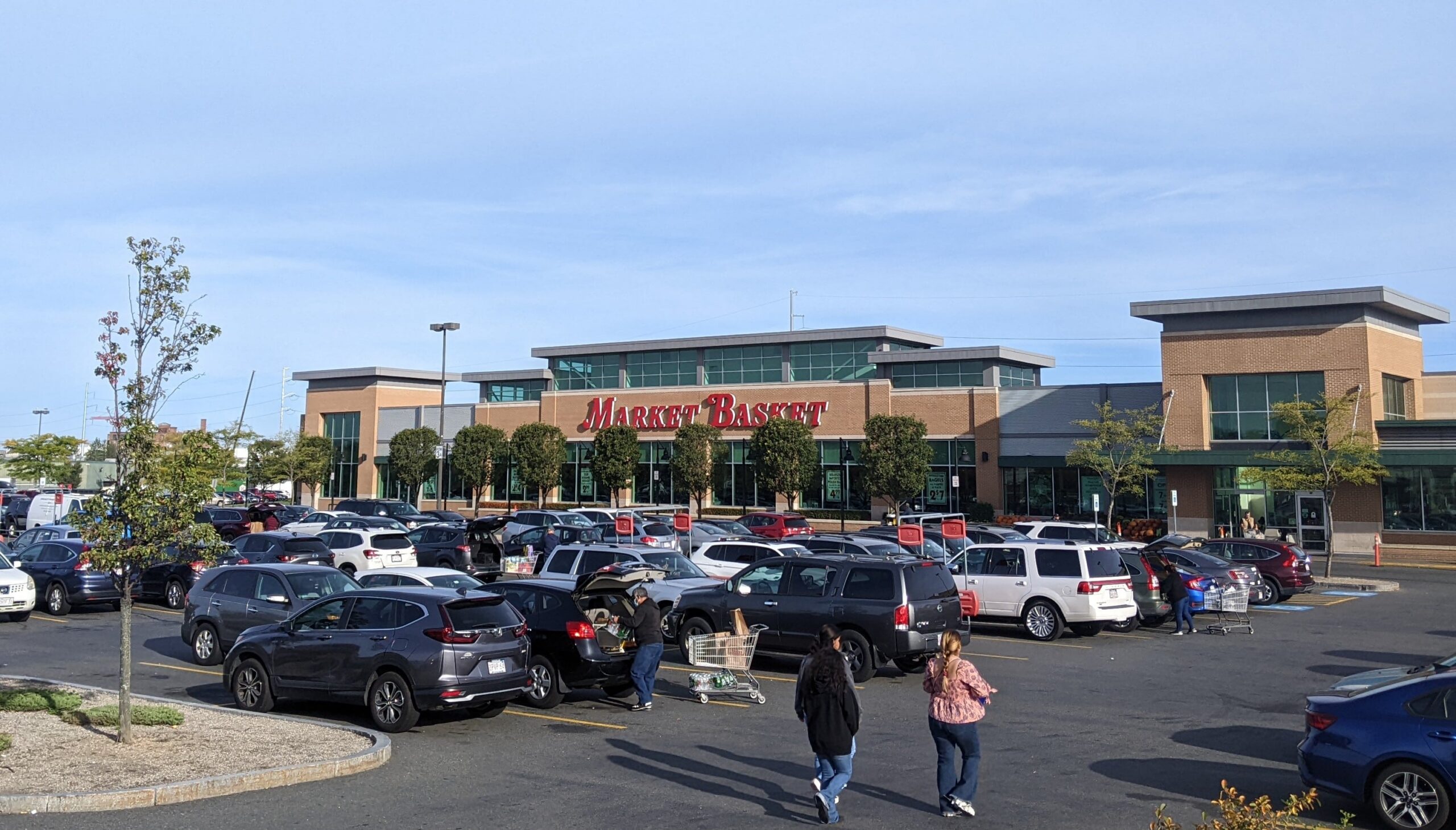
Chelsea's Market Basket store in 2022. Photo by James Sanna | Banker & Tradesman Staff / File
A pair of lots – largely empty save for persistent flocks of seagulls and pigeons – next to Chelsea’s commuter rail station could become apartments.
That’s according to a master plan floated by Market Basket grocery chain parent Demoulas Super Markets, a plan that the Chelsea city manager is embracing.
A copy of the plan prepared by Chelsea-based design firm The Architectural Team and provided to Banker & Tradesman by the city of Chelsea suggests adding 162 apartments in two mixed-use buildings with structured parking to the Mystic Mall property, plus an additional trio of retail outbuildings on the opposite side of the site. The Boston Globe first reported the plans.
Demoulas Super Markets owns the retail plaza near the Chelsea-Everett line, which holds its highest-grossing store, and around 70,000 square feet of additional retail space in several outbuildings. But since its redevelopment 15 years ago from an enclosed mall built to replace Chelsea’s “rag district” after a massive 1973 fire, a pair of 1.25-acre lots along the Second Street side of the site have sat largely unused. One holds a parking lot largely used to store snow and snow-removal equipment, the other remains grassed-over. In an interview, City Manager Fidel Maltez called them “the pigeon parcels.”
“It’s a magnet that pulls people into Chelsea,” said Maltez, explaining that Market Basket and the city have been working together to develop the concept for about a year. “We’re trying to leverage all of that interest to maximize the potential of the site.”
Market Basket would still need to engage a private developer to make the buildings happen, Maltez said, and no formal plans have yet been proposed for the Mystic Mall site beyond updates to the parking lot and a large, new MB Spirits liquor store set to open Friday.
If formal proposals for new housing are eventually brought forward, though, the city is trying to smooth their path.
Market Basket’s plans would leverage the city’s four big MBTA links – a commuter rail station and the SL3 bus rapid transit line’s terminus behind the Market Basket store, and the 111 and 104 high-frequency bus lines nearby – and new zoning for the area adopted in June expanding on the city’s MBTA Communities district. The West Chelsea zoning overlay removes parking minimums, minimum lot size and minimum frontage requirements, and sets a maximum of 12 stories or 150 feet and a 7.0 floor-area ratio for buildings. Potential lot coverage maxes out at 75 percent and multifamily uses are allowed by right.
The city also recently slashed its inclusionary zoning requirement for multifamily housing. Developers of projects with 100 units or more now have a choice of setting aside either 10 percent of units for renters making 80 percent of area median income, or 7 percent of units for those making 60 percent of area median income.
The new rules largely mirror those in Everett, Maltez said, and respond to developer feedback that the city’s old rules made it impossible to finance new housing, and resident feedback gathered during the city’s recent master planning process, “¡Chelsea Palante!” The other aim, he said, is to attract more tax dollars to fuel the services the largely working-class city needs.
“We see development as a means to an end,” Maltez said. “Yes, we do want [new] housing to get more taxes, but our residents also want more housing. We want more housing for everyone. We want all types of housing. We want income-restricted housing. We want market-rate housing. We want infill housing. We want to make it easier to build housing in Chelsea.”
The new zoning district could also open a large office portfolio across the street for redevelopment. The North Colony Asset Management-owned site has significant parking lots that the city hopes could also host new housing, Maltez said, part of a larger trend that’s seeing office park owners around the Boston area turn to housing-focused redevelopment to buttress flagging occupancy rates, especially along the Route 128 corridor.
To get the Market Basket projects and others out of the ground, Maltez said, the city would consider long-term tax abatement deals, noting the city’s experience using them to attract a number of new hotels and the regional FBI headquarters tower.
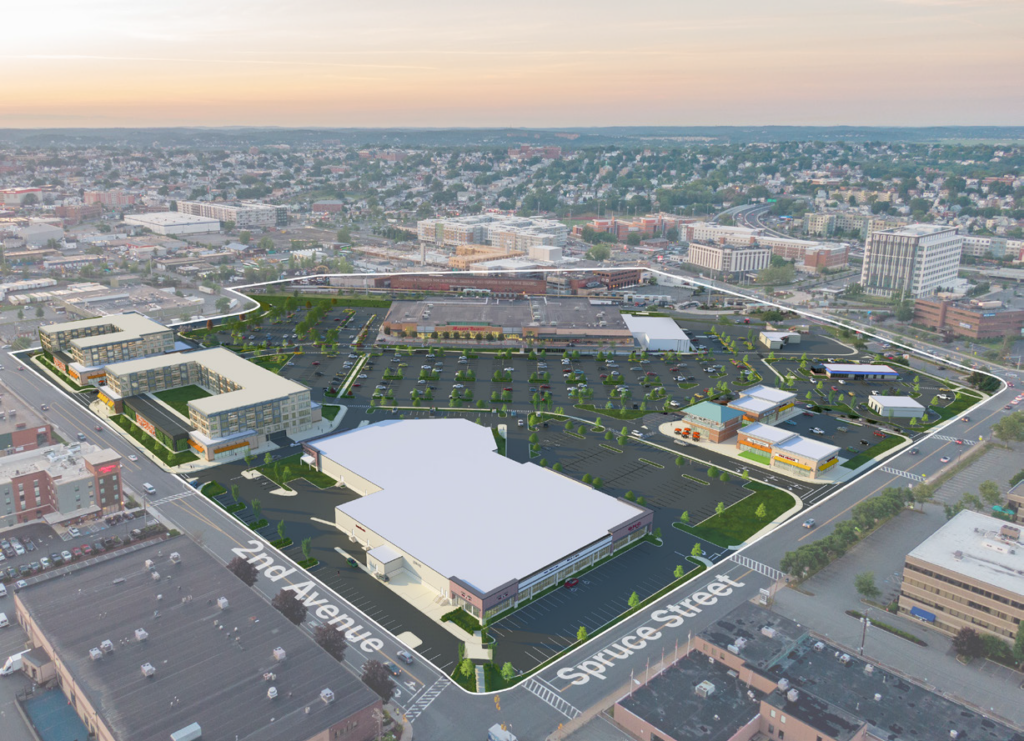
Two apartment buildings with a total of 162 units (left) could rise next to Chelsea’s Market Basket grocery store under a conceptual plan floated by store owners. Image courtesy of The Architectural Team