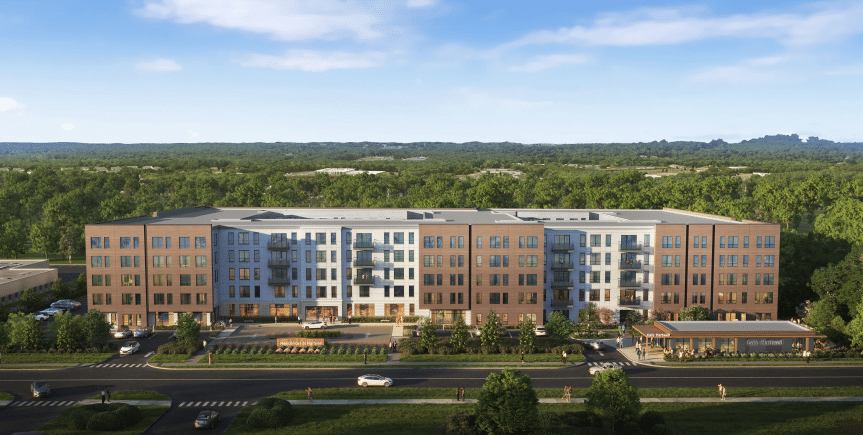
BXP's planned redevelopment of a Lexington office property includes 312 apartments. The company recently told Waltham officials it wants to add 1,500 new homes in office parks it controls there. And it’s planning 480 new units in a Weston MBTA Communities district. Image courtesy of CUBE 3
Let’s face it: We are in danger of losing the race to solve Greater Boston’s housing crisis, as it slowly but steadily wrecks New England’s biggest economic engine.
Despite lots of cheerleading by elected leaders and new laws reforming some municipal NIMBY zoning rules, new housing construction in Boston and across the state has been on the decline after a short burst of activity during the pandemic years of the early 2020s.
In fact, Massachusetts will likely face a significant challenge in meeting the Healey administration’s arguably low-ball goal of 200,000 new housing units over the next decade or more.
But amid the gloom, some modest rays of hope suggest that battle to boost housing production isn’t hopeless either and that progress, while it can be slow, is possible.
Enter: Boston Properties, one of the nation’s largest developers and owners of high-end, downtown office towers and suburban office parks.
BXP has been quietly expanding into the world of residential development amid seemingly-permanent lower demand for new office space.
And that can only be good news for efforts to boost residential construction in Massachusetts.
BXP’s 4M SF of Developable Land
Most developers face a huge challenge getting new apartment and condominium buildings and single-family subdivisions through the local approval process, which can take years.
Add to that the challenges of obtaining financing, and projects can be stuck in limbo for years.
NIMBY local officials and homeowners have turned obstruction and delaying tactics into an art form, knowing that chronic delays can kill a project as surely as an outright rejection.
But guess what? Boston Properties has the kind of heft and resources needed to push plans for new housing through the permitting process, and with the deep pockets to finance projects off its own balance sheet, should it come to that..
The company currently owns more than 4 million square feet of developable residential land locally in Weston and Waltham, as well as in the Virginia and Maryland suburbs of Washington, D.C., according to company financial filings
And BXP has options to buy residential development sites totaling another 3 million square feet of space in Boston, Cambridge and Waltham.
That’s a substantial amount of land for new multifamily projects, surpassing 7 million square feet and smaller than, but hardly dwarfed by, the 11 million square feet of land for potential office towers and buildings the company controls in the same markets, company filings show.
Nor are these just paper plans. Boston Properties is seeking a green light from Waltham officials to build housing at the Bay Colony office park, the Waltham Weston Corporate Center, and on a vacant Main Street tract, Banker & Tradesman reported last week.
All told, BXP is looking at developing as many as 1,500 new housing units in Waltham, company officials have told the city.
That’s on top of the nearly 500 they want to build on an office park that got upzoned by the MBTA Communities law and a 312-unit complex under construction in Lexington, where town officials are hoping to revitalize their office parks by adding housing and retail.
That, in turn, could certainly provide a badly needed jolt to housing production in the Boston area.
Some MBTA Communities Progress
As for our other modest ray of hope, that would be a new report by Amy Dain, a senior fellow at Boston Indicators, the research arm of The Boston Foundation.
The hard-fought MBTA Communities law won’t solve Greater Boston’s housing crisis, but it is set to produce some housing, Dain’s report finds

Scott Van Voorhis
More than 7,000 housing units currently under construction or in the permitting and planning stages certainly count as a modest win, according to Dain. On top of that, the law normalized the idea of as-of-right multifamily zoning, sparked a conversation about where Greater Boston should grow and catalyzed dozens of local pro-housing groups, she argues.
Thirty-four towns are now reviewing plans for projects, with several even bigger than BXP’s 480-unit Weston project, per the report.
Still, one problem with the 2021 law, which has continued to hamper housing development, is that those less eager to see new apartments built in their towns have been able to find loopholes.
While state lawmakers wanted to provide local communities with flexibility, some local officials, determined to limit new construction, have taken advantage of its “leeway” to “sidestep the law’s housing goals,” Dain said in a statement.
That said, the housing units in the pipeline as a result of the MBTA Communities Act, like Boston Properties push into residential development, represent progress, however modest.
And some progress – and plans for new housing – is far better than none
Scott Van Voorhis is Banker & Tradesman’s columnist and publisher of the Contrarian Boston newsletter; opinions expressed are his own. He may be reached at sbvanvoorhis@hotmail.com.