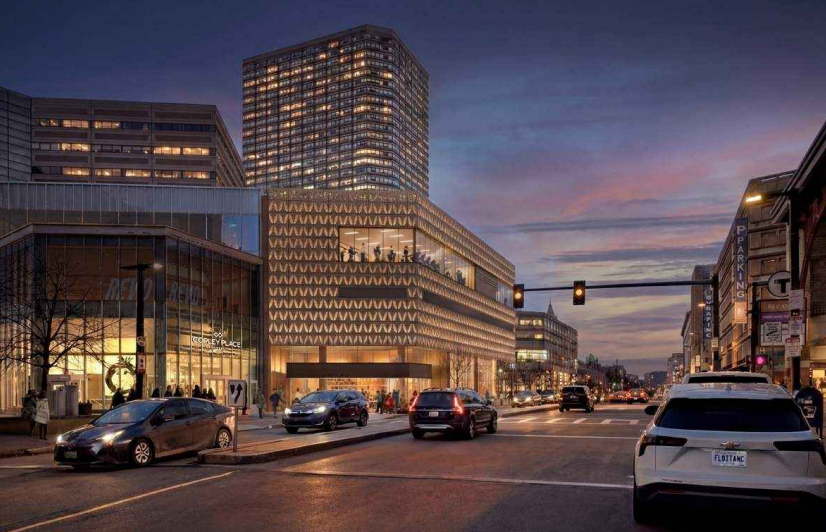
Potential changes to the exterior of the Neiman Marcus wing were submitted to the Boston Planning Department by Simon Property Group as it prepares to convert the anchor wing into multi-tenant space. Image courtesy of Gensler
Simon Property Group should have no problem filling the now-vacant Neiman Marcus wing at Copley Place for a very simple reason: The luxury retail and food-and-beverage sectors are doing well in Boston, thank you.
Indianapolis-based Simon, owner of Copley Place in Boston’s tony Back Bay, earlier this year announced plans to subdivide the old multi-floor Neiman Marcus space into smaller upscale retail stores and eateries.
The nation’s largest shopping mall owner, Simon has already signed up two highly regarded restaurants to help fill the 100,000-plus square-foot void created by Neiman’s closure this month: Miami-based Casa Tua Cucina and Estiatorio Milos, a Greek seafood restaurant.
Simon remains mum on what other high-end establishments might be coming to Copley Place after a partial redevelopment of the enclosed urban mall. A Simon spokeswoman would only say that there’s “exciting news to come soon.”
Simon Property Group has been in discussions with the Boston Planning Department since November on the changes to the property. The agency has asked developers to consider adding street-facing retail on the ground floor of the Neiman Marcus wing, according to a presentation obtained by Banker & Tradesman under a public records request.
Experts See Strong Leasing Demand
Local retail real estate experts say they have no doubt Simon will ultimately find the type of luxury tenants it needs and wants to replace Neiman Marcus.
“I can’t imagine Simon having any problems filling that space,” said Whitney Gallivan, a partner at Boston Realty Advisors. “It’s a no-brainer. Back Bay is stronger than it’s ever been. It’s a very tight [retail] market. And Copley Place already has strong co-tenancy that other retailers like.”
Ann Ehrhart, the founder and head of Everstreet, a retail strategy, consulting and leasing firm in Boston, agreed that Simon’s goal of replacing a large department store like Neiman with multiple smaller upscale shops and restaurants is the way to go.
“With Neiman’s closing, you might hear some people say ‘Gosh, what’s happening in retail?’” said Ehrhart. “But there’s really a change underway in retail. There are just fewer larger retailers. They’re shrinking in size and numbers – and that’s what you’re seeing with the Neiman closing.”
Indeed, the nationwide retreat of major retailers has been ongoing for a while now, amid heightened competition from e-commerce companies and the changes in shopping patterns caused by the recent pandemic.
Suburban Malls Point to a Pathway
In the suburbs, a number of retail shopping malls have effectively failed due to the loss of key anchor tenants, forcing many owners to redevelop the malls into mixed-use retail, restaurant, and residential sites.
Neiman’s recent closure at Copley Place – spurred by the January bankruptcy filing by its parent company, Saks Global – is merely part of the overall trend of struggling department stores across the region and country, experts say.
But fortunately for Simon, the Neiman closure comes at a time when smaller luxury retail stores and high-end restaurants are doing well across the country – and particularly in Boston.
In recent years, Boston has emerged as a highly attractive market for premium retailers – and the upscale Back Bay has become a primary beneficiary of that market evolution.

Simon Property Group is preparing to refresh the Neiman Marcus wing of its Copley Place mall, the latest property to swap anchor space for smaller specialty retailers. Image courtesy of Gensler
Some rents along Newbury Street have reached as high at $500 per square foot for triple-net leases, Everstreet’s Ehrhart noted, while other rents hover in the $150 to $175 range for smaller townhouse shops with exterior stairways.
Somewhere in between those eye-popping numbers are lease prices at Copley Place, host to such luxury brands as Gucci, Versace, Louis Vuitton, Loewe, Tiffany & Co., Saint Laurent and Burberry, among others.
Not only has the Back Bay – and Copley Place in particular – benefited from the surge in luxury spending in Boston. So has Boston’s relatively new Seaport District.
New Competition from Seaport District
Dave Downing, managing director of leasing at Graffito SP, an urban retail brokerage and advisory firm in Boston, said Back Bay and Seaport may share some high-end retail and restaurant market traits.
But he said Seaport, which only three decades ago was mostly known for its huge swaths of gravel-covered parking lots, is today better known for its strong food-and-beverage scene than its tony retail offerings.
Back Bay, on the other hand, is known for its strong portfolio of high-end retail shops mixed with an array of upscale and other types of eateries.
In the end, both neighborhoods have adapted well to recent e-commerce and COVID-related changes that have wreaked havoc within many subsectors of retail, Downing said.
Among those changes are fewer people working in offices and more people working from home; the move by many families to more rural areas; increased demand for home food and other product deliveries; and the decline of after-work socializing on Friday afternoons, Downing said.
There’s also the fact that society appears to be more economically bifurcated today than in the past, with less affluent “value consumers’” on one end and more affluent luxury-seeking consumers on the other end.
“We seem to be settling into a new normal,” said Downing of the retail and restaurant scene in general.
And Copley Place has most definitely settled on the upscale side of that new normal.
“They’re really establishing themselves in that ultra-luxury, curated and high-spend-per-visit” space, Ehrhart said.
Banker & Tradesman staff writer Steve Adams contributed to this report.