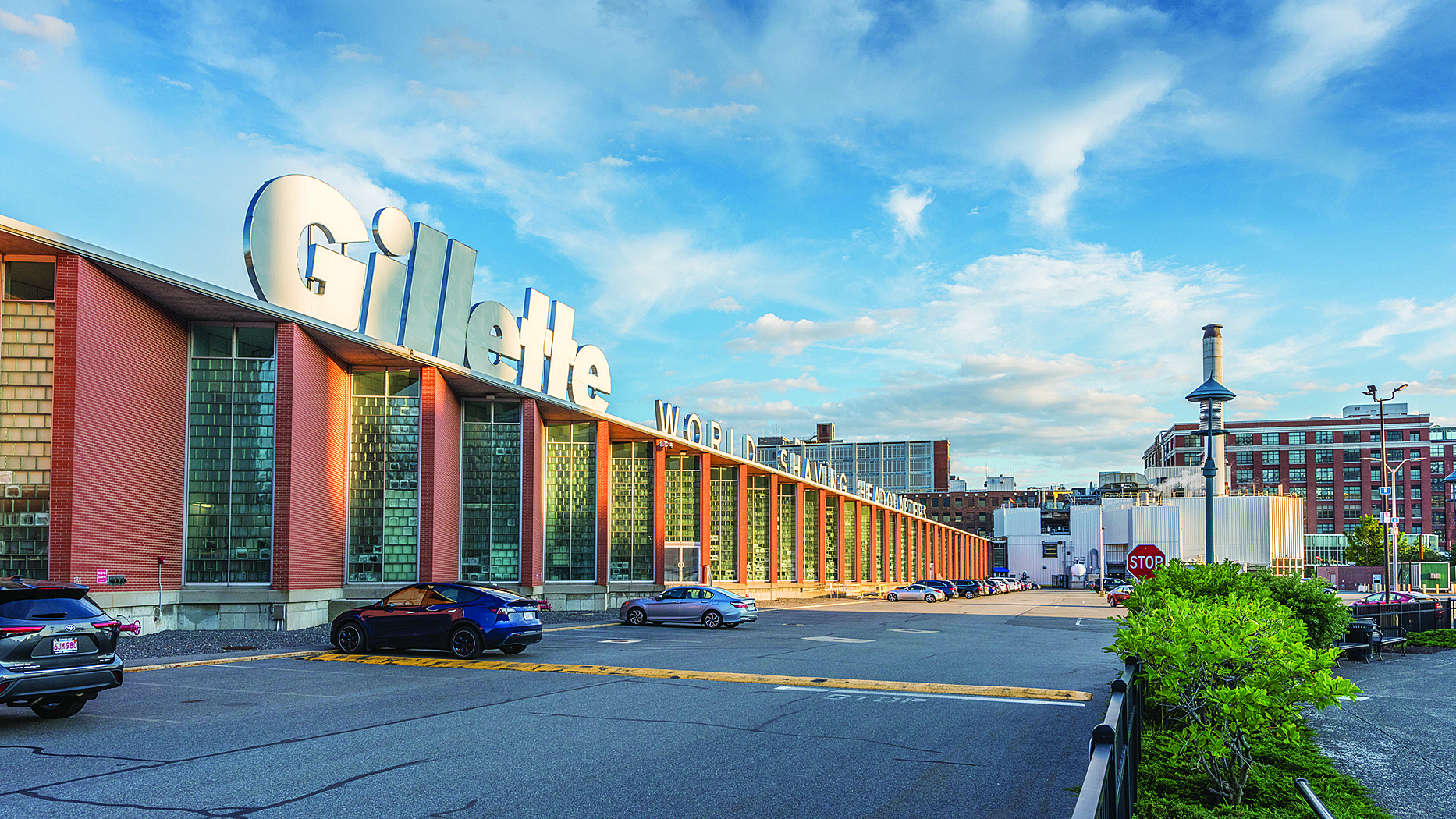
Nearby artists in Boston’s Fort Point neighborhood want Gillette to set aside a large-enough parcel for a marquee arts and civic venue as it redevelops its 31-acre South Boston campus. iStock photo
Boston’s Seaport District and its jumble of eclectically designed office and residential high-rises, each different in some aspect of facade or shape, is finally nearing full build-out.
And in what could be the last big opportunity of its kind in the waterfront district, shaving giant Gillette and its parent company Proctor & Gamble are forging ahead with plans to redevelop its 31-acre site near its long-time manufacturing plant that stretches from south of the Seaport to South Boston.
Now sensing a last chance here as well? That would be the artists in the nearby Fort Point neighborhood, who are pushing the city and Gillette for a large, “signature” arts, cultural and civic venue as part of the redevelopment of the Gillette site.
Sure, the Seaport does have the eye-catching ICA – which is fantastic – and some smaller arts and performance spaces.
But some in the Fort Point arts community are thinking bigger as they envision a marquee waterfront hall, one that would serve as a focal point for one of the newest sections of one of our nation’s oldest cities, per public comments filed with Boston’s Planning Department on the Gillette project.
Will Mayor Lean on Gillette?
However, the jury’s out on whether the Wu administration is ready to go to the mat for an arts, culture and civic palace of the size and scale some artists have set their sights on, or will push the artists to accept a more modest plan.
Last week, City Hall published its response to Gillette’s proposal. Boston Planning Department officials are calling for at least 1 acre to be set aside for a major performance, civic, and cultural venue.
That’s not a lot for a development next to a neighborhood that’s been a major arts hub since before The Cars played Fort Point’s former The Chanel nightclub, given that the Museum of Fine Arts sits on 12 acres.
For context, the ICA sits on about 0.87 acres, per the city’s online property tax map.
“I share the concern about continuing to squeeze out artists and places for art,” said Michael Bourque, a Fort Point resident and award-winning artist who has pursued “parallel interests” over the years in design, painting and photography.
“Any other city would take great pride in continuing that legacy and fostering a thriving arts community,” Bourque said in an email. “I oppose any future development that whittles away at what makes Fort Point and Seaport so special as a neighborhood. Neighborhoods are about people and not buildings or corporations.”
That said, it is still early in the review process for the Gillette project, with many more reviews and community meetings surely ahead.
“The Civic/Cultural space is a critical component of this project,” a spokesperson for the Boston Planning Department said in a statement. “We appreciate the arts community’s advocacy and we will continue working with P&G and community members to refine the proposal.”
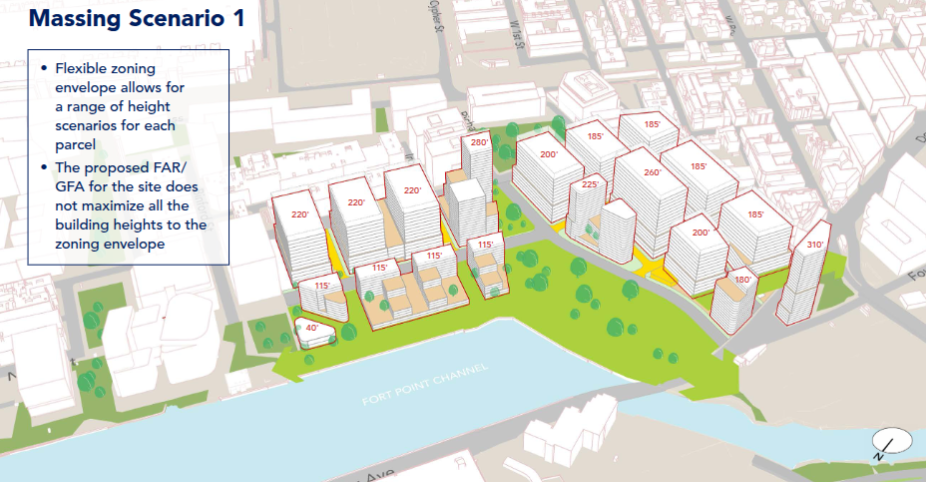
One of several massing scenarios presented for redevelopment of the Gillette campus in South Boston. Image courtesy of CBT Architects
Few Remaining Plots for Arts
In its filing last week, city planners referred to an arts site of no less than 1 acre, the verbiage unchanged from previous filings and documents.
However, it was significantly less than what some local artists had expected to see in the document.
Don Eyles, an artist who has lived in the Fort Point neighborhood since the 1980s, contends the site should be at least 2 acres, with the structure itself at least 400,000 square feet, per comments he submitted last year to city officials.
“The public has expressed overwhelming support for a ‘signature’ civic and cultural destination,” he wrote. “This facility is a shared responsibility, equivalent to believing in the future of Boston, as our ancestors did when they built Symphony Hall, the Emerald Necklace, the Museum of Fine Arts.”
In fact, there’s a question about whether there had been an informal understanding between Fort Point artists and city planning officials about a 2-acre site, only to have it overruled by the administration.
It’s also a far cry from the 5 acres that Mayor Michelle Wu, during her time as a city councilor years ago, once argued should be set aside in the Seaport for just such a marquee project.
But much has changed since then. The waterfront district has been steadily built out with new mid-rise glass-and-steel blocks, which have limited the number of potential sites for an arts project.
Gillette’s 30-plus acres of parking lots and older buildings represent one of the last major undeveloped tracts in the Seaport and maybe one of the last chances to build a new, major performance hall.
For arts groups dreaming of a signature project, it really is now or never.
Scott Van Voorhis is Banker & Tradesman’s columnist and publisher of the Contrarian Boston newsletter; opinions expressed are his own. He may be reached at sbvanvoorhis@hotmail.com.