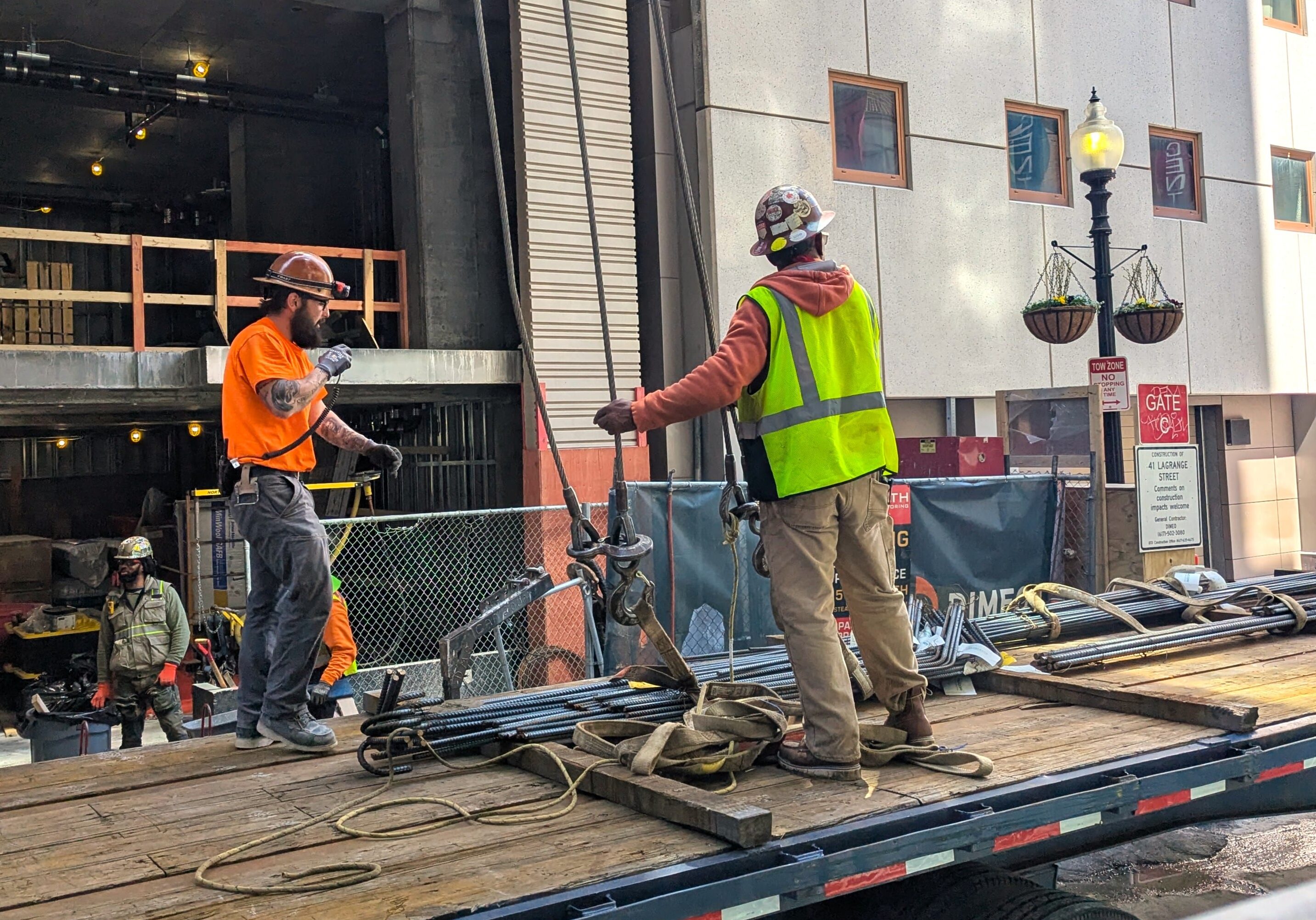
Construction workers prepare to lift rebar to the upper floors of a mixed-income housing development on LaGrange Street in Boston’s Theater District in May 2025. Construction union officials say thousands of their members are out of work due to the lack of real estate development. Photo by James Sanna | Banker & Tradesman Staff / File
Danny McWilliams has a December Boston Globe column posted on his office wall at Ironworkers Local 7 in South Boston.
And McWilliams, a business agent for a union that represents thousands of ironworkers across Massachusetts, Maine and New Hampshire, didn’t mean it as a positive.
“Mayor Wu has focused on jobs, not real estate, to grow the city’s economy. It’s paying off,” the Globe declares with a headline that looks like it came straight from the mayor’s press office.
Michelle Wu is a different kind of Boston mayor than her predecessors, or so says the piece’s author, Globe business columnist Shirley Leung. A mayor who measures success not by “the number of construction cranes in the sky,” but rather “the number of residents with good-paying jobs.”
Since it was published, the headline and the column have stuck in McWilliams’s craw, and it’s not hard to see why.
Boston’s once epic building boom has gone bust, taking with it bustling construction sites, countless well-paying jobs and a whole lot of tax revenue.
And the ironworkers of Local 7, who a few years ago were busy working on any number of new towers taking shape on Boston’s skyline, have been hit hard.
Thousands of Tradespeople Out of Work
Out of Local 7’s 2,800 members, roughly 1,000 are out of work, up from practically nil just three or four years ago as the building boom of former Mayor Marty Walsh’s term was entering its final phase, McWilliams said.
Yet the mayor seems to dismiss the key role that construction and real estate development plays in fueling Boston’s economy.
Or, as the Globe headline suggests, Wu “has focused on jobs, not real estate, to grow the city’s economy.”
Which all sounds nice and fine until you realize that it is actual people who build the new buildings, and that in Boston, most are highly skilled, well-paid union members.
“The headline says it all,” an incredulous McWilliams told me over coffee one morning earlier this week at a Dunkin near Watertown Square.
“This is the most unemployment we have had in a long time,” McWilliams said, comparing current conditions to the Great Recession nearly two decades ago.
Local 7 ironworkers are taking part-time jobs at Target and hitting the road to work on projects as far afield as SpaceX’s big expansion of its Texas base and a new stadium in Tennessee, he noted.
And it’s not just the ironworkers. The IBEW, which represents union electricians and workers in the natural gas industry, has been hit hard as well.
“There are currently over 1K unemployed electricians across Massachusetts while the vast majority of states across the country are having a difficult time finding enough electricians to complete the work,” IBEW Second District International Vice President Michael Monahan said in an email.
“Energy policies in Massachusetts and New England, combined with affordable housing percentages, are putting projects where they can’t get financing,” Monahan added.
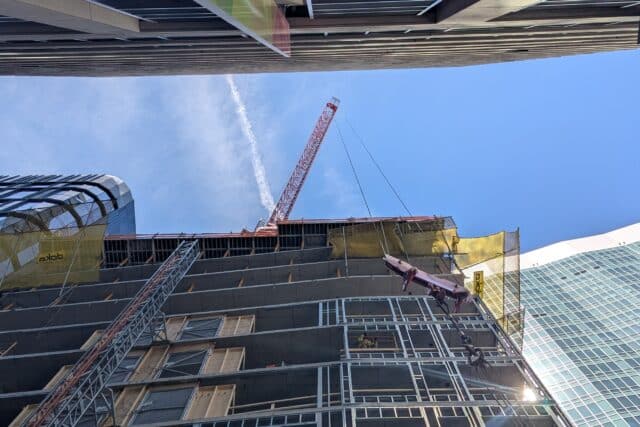
The arm of a crane perched on top of the under-construction 41 Lagrange St. affordable housing tower sticks out into the gap between the building and its neighbor across the street in May 2025. Photo by James Sanna | Banker & Tradesman Staff
Job Growth Claims Don’t Add Up
Wu isn’t to blame for the interest rate surge that forced bankers to rethink their support for development projects across the country.
But the Boston mayor’s insistence on barreling ahead with expensive new green energy and affordable housing mandates made a bad situation far worse, say local developers and union building trades leaders like McWilliams.
Some of the big names in local development, like Joe Fallon, who built out the Seaport, have left Boston in frustration to pursue major projects in fast-growing Sun Belt cities and states.
“You have to try to listen to what developers are saying,” McWilliams said. “I know you can’t give away the house, but you have to work with them, and she is not even doing that.”
Instead, Wu has been focusing her job-creation energies on a range of training initiatives and private-sector industry partnership programs with life sciences and clean tech companies and health care institutions.
And Wu’s focus on people over buildings is now paying dividends with a 2.7 percent increase in the number of jobs in Boston since the mayor’s first year in office in 2022, according to the Globe’s Leung.
What Leung’s column doesn’t mention? The stat is only a rough proxy for Boston and, more importantly, includes both government and private-sector jobs.
However, when you take out the government jobs and just look at private sector job growth in Boston, Leung’s case that Wu’s policies are working falls apart.
By the end of June 2025, companies in Boston and the rest of Suffolk County shed more than 7,600 jobs over the previous 12 months, lowering the total to 625,000, according to the federal Bureau of Labor Statistics.
During Wu’s entire first term, the private sector in Boston and Suffolk County added about 700 new jobs.
That’s an increase of 0.11 percent, a far cry from the 2.7 percent increase that Leung’s column cites, without mentioning that it included state and city government jobs.
By comparison, businesses in Boston and Suffolk County added more than 95,000 private sector jobs between the second quarter of 2014, Walsh’s first full year in office, and the second quarter of 2019, his last full year, federal job stats show.
That’s a gain of 17 percent.
Mayor Minimizes Heart of City’s Problems
To be fair, Leung briefly mentions near the top of her piece that new construction has stalled out in Boston, as well as another brief allusion further down to the fact that all may not be well in Wu’s Boston.
As commercial real estate taxes fall amid the drop in new projects and construction, it “may ultimately force Wu to reckon with her rocky relationship with developers,” Leung writes.
Let’s get real here: Boston is facing its biggest financial and economic crisis in generations.
The collapse in new development, combined with crumbling office tower values from the shift to remote work, is expected to wipe out as much as $2 billion in tax revenue in the coming years. Its early effects are already starting to forcing painful school cuts while relentlessly pushing up taxes on city homeowners.

Scott Van Voorhis
Yet these are treated as no more than minor asides in Leung’s assessment of Wu’s performance, rather than the central challenge facing her administration and Boston.
Wu’s approach to the collapse of construction and development in Boston has been to pick fights with the real estate industry and various business leaders, while doing her best to minimize or simply ignore problems that are becoming increasingly urgent and unignorable.
Michelle Wu is a skilled, maybe even brilliant politician. In contrast to some other hapless, blue-city mayors, she has provided effective pushback to dangerous Trumpian overreach and power grabs.
But her record as a big-city mayor has proven to be problematic, to say the least.
And without a major course correction, Wu and the city she claims to be governing are headed for disaster.
Scott Van Voorhis is Banker & Tradesman’s columnist and publisher of the Contrarian Boston newsletter; opinions expressed are his own. He may be reached at sbvanvoorhis@hotmail.com.