
The number of single-family homes for sale was up 2.1 percent statewide in July. iStock illustration
As the days get shorter and the temperatures get cooler, the residential real estate market could be poised for an active fall market after a slow start to the year.
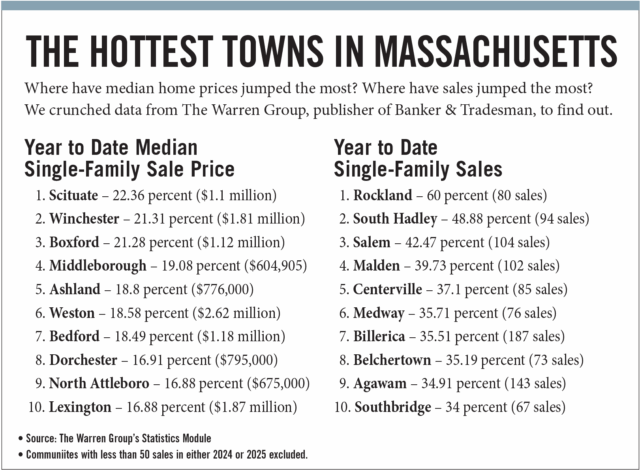
There were 23,784 single-family home sales in the first seven months of 2025, a 3.6 percent increase from 2024 according to The Warren Group, publisher of Banker & Tradesman. The median single-family home sale price increased 3.4 percent on the same basis to $640,000.
“It was very much a start-stop market in the sense that we’d see it very busy for one to two weeks, and then all of a sudden it would halt for a week, and I would get busy for one to two weeks,” Cross Country Mortgage Senior Vice President Andrew Marquis said of the spring market. “I think a lot of that was the geopolitical uncertainty with regard to tariffs and how that sort of bounced rates up and down, and the unpredictability of the future.”
Through the first four months of the year, 10,349 single-family homes sold throughout the state, representing just a 2.1 percent increase.
 The instability in the market had a more concentrated effect on the higher end of the market.
“Needs-based purchases, they moved along very nicely, enjoying that tailwind but discretionary purchases are usually always the first thing to get a pause in an uncertain market,” said Pauline Bennett, New England regional vice president at brokerage Coldwell Banker.
Along with economic instability, winter weather and a new president played a role in a slow start to the year, said Anthony Lamacchia, broker and owner of Waltham-based Lamacchia Realty.
Inventory Creeping Back Up
But as the calendar has inched towards the fall, certainty seemed to creep back into the bond market and the larger economy, and mortgage rates have begun to trend downwards. The weekly average mortgage rate dropped to a 10-month low of 6.58 percent according to mortgage-buyer Freddie Mac.
With rates trending downwards and some homes left unsold this spring, inventory has increased.
According to the Massachusetts Association of Realtors, the inventory of single-family homes for sale in Massachusetts increased by 2.17 percent to 7,380 homes in July. While single-family inventory fell in the five-county Greater Boston region, it was up 9.1 percent on Cape Cod and up 10.4 percent in Worcester County.
Condo inventory in Massachusetts increased by 8 percent on a year-over-year basis, to 4,006 homes, with much of the jump coming from Greater Boston.
That steady increase seems to be showing up in home sales. According to The Warren Group, there were 4,719 single-family home sales in Massachusetts in July of 2025, an increase of 6.2 percent from the year prior.
Still, Massachusetts has just 2.2 months of inventory according to MAR 2025 President Sarah Gustafson, and this still means that the state is considered to have a critical housing shortage.
“Being less than three months of inventory is still considered a critical housing shortage so it’s positive in the sense of we’re finally seeing some relief and more homes coming on the market. However, that’s coupled with the fact that we’re still far below where we should be for a balanced market,” she said.
Fall Market Commentary
Al Becker: Pricing Strategies in a Shifting Market
Colleen Barry: Why Agent Education Matters in a Rapidly Changing Industry
Cheryl Eidinger-Taylor: Central Mass. Residential Real Estate Market Now Balanced
Merit McIntyre: Don’t Mess with the Market – Please!
‘Best Time to Buy’?
Along with increased inventory levels and declining interest rates, the Federal Reserve has indicated that there could potentially be a rate cut in September.
While the Fed doesn’t directly control mortgage interest rates, in normal times cuts in its benchmark short-term rate influence different parts of the financial system in ways that ultimately pull long-term interest rates like those on Treasury bonds and 30-year fixed-rate mortgages down.
While the fall has historically been a better time to buy than sell, Lamacchia believes that this fall presents a particularly good opportunity for buyers.
“I think rates are getting better,” he said. “There’s no election this fall. People have realized that the world’s not going to cave in over tariffs, and people that have been putting off buying and selling, I think they’re going to be in more action now.”
But while the gap between the low interest rates seen during the COVID-19 pandemic and current rates could be reduced this fall, potential sellers attached to their current, pandemic-era mortgage rate will still face some challenges coming to market.

President Donald Trump points at a cost figures document Federal Reserve Chairman Jerome Powell is reading during a visit to the Federal Reserve headquarters, Thursday, July 24. The feud between the president and the central bank could threaten mortgage rates’ slow decline this fall. Photo by Julia Demaree Nikhinson | Associated Press / File
“The lower interest rates aren’t necessarily going to translate to a big flood of the market,” said Cape Cod & Islands Association of Realtors 2025 President Todd Machnik, who’s also the president of Harwich-based Today Real Estate. “I don’t think it’s significant enough drop to generate that many more people selling to buy up.”
Wild cards, like the bond markets’ reaction to President Donald Trump’s escalating war with the Fed or dramatic changes in the tariff landscape, still hang over mortgage rates’ potential direction this fall.
If all stays calm, while rates might not plummet back to what was seen during the pandemic, Marquis still believes things will continue a trend of steady improvement.
“We’re in a slowly improving market,” he said. “Everyone wants the rate to go from 7 [percent] back down to 3 percent and that just isn’t happening. It’s a very slow roll to these lower rates but at the same token, I think that we’re seeing a slow roll to more activity in the real estate market. More borrowers coming to the table, more buyers and sellers coming to the table, year over year. I think that trajectory will continue into the future.”
Bullish on Inventory Picture
Bennett is also bullish on the fall market, but based on the increase in inventory seen throughout the state so far this year.
“I do think that there’s good inventory out there and I do think buyers, when they enter the market, now they’re entering at a different pace than perhaps they were before,” she said. “They’re not encountering the multiple-offer situations, needing to waive all contingencies to be competitive. Buyers are having an opportunity to be competitive today that they didn’t have in the height of the market in 2021.”
Heading into the fall, Gustafson, who’s also a broker with Keller Williams Pinnacle Central in Worcester and Keller Williams Pinnacle Metrowest in Westborough, noted that sellers can’t count on a tight market letting them set higher prices.

Sam Minton
“That’s the thing the sellers are going to need to be really cognizant of,” she said. “Understanding that going into the fall market, there may be more inventory in their areas, being cognizant of that, seeing where things have sold, into the spring and into the summer. We’ve seen days on market tend to increase this time of year. So places that may have sold in a week or two in the spring may take a little bit longer in the fall.”
Gustafson said that she tells her clients that it is crucial to remain competitive in the current market and to not base their expectations on what happened in the spring.
Today, sellers are facing down much smarter buyers, with access to much more sophisticated tools than even a few years ago.
“Buyers that are actively in the market, I think, are actually more in touch with value than sellers, because they’re watching everything that’s coming on to the market,” Bennett said. “They’re becoming students of the market. They’re looking at it and watching it every day. They become educated very quickly on what their sense of value is, and when a property comes on the market.”