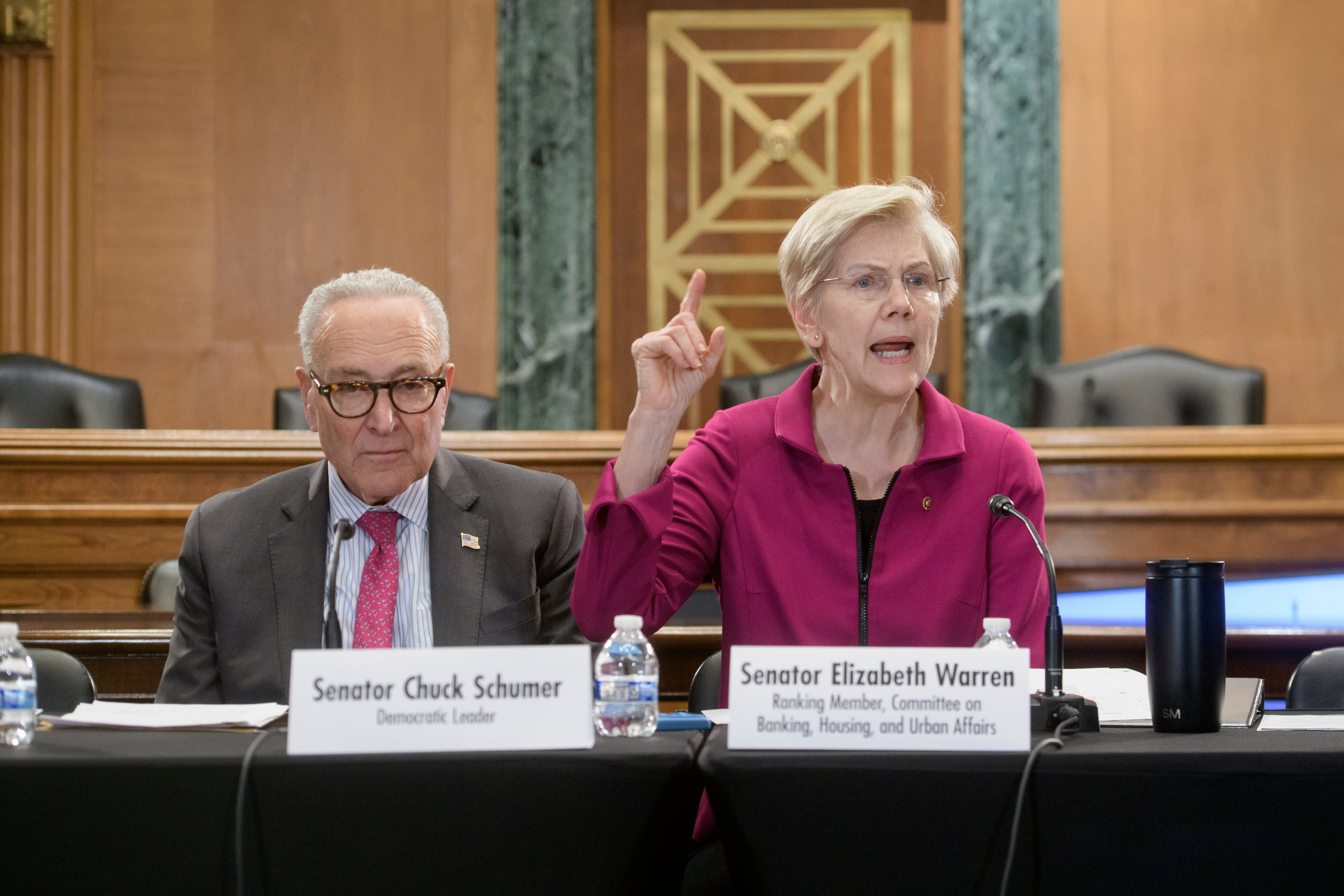
Sen. Elizabeth Warren and Senate Minority Leader Charles Schumer, D-N.Y., left, speak during a round table discussion on the high cost of housing, on Capitol Hill, Wednesday, Jan. 7, 2026. Photo by Rod Lamkey Jr. | Associated Press
There is more than a little mentor-mentee, protege relationship between Sen. Elizabeth Warren and a certain former law school student of hers.
That would be Boston Mayor Michelle Wu. A student of Warren’s at Harvard University Law School who went on to work on one of the senator’s campaigns, Wu as mayor has hired staffers from the senator’s office for jobs at City Hall.
So how awkward is this? Warren’s big bill to boost housing construction across the country would also single out cities, like Wu’s Boston, that aren’t pulling their weight.
They may be bosom buddies and all that, but it’s hard to imagine Wu was thrilled with one of the key provisions of the big, bipartisan housing bill Warren has championed down in D.C. The 21st Century ROAD to Housing Act, which cleared the Senate 89-10 last month, would penalize some cities and reward others based on their housing production track records.
If passed, federal officials would wield Community Development Block Grant money as carrot and stick in their bid to pressure cities to up their act when it comes to housing production.
Underperformers would get fewer federal block grant funds – to the tune of 10 percent – under the ROAD to Housing Act, with the money being reallocated to cities with a better than average track record in new house, apartment and condominium construction.
All that would be very bad news for Boston, which potentially stands to lose millions of dollars in federal housing and economic development money, thanks to a big drop in new apartment and condo development.
Boston’s Lagging Housing Starts
Boston received $20 million in federal CDBG money in 2024, so this is not an insubstantial sum we are talking about.
With Boston facing major budget woes, even the loss of a few million dollars could cause problems, while also casting a spotlight on a key facet of Wu’s record that she has done her best to gloss over.
By 2024, Boston had fallen to the bottom tier of the national pack in housing construction on a per-capita basis, according to Boston Globe reporting from the middle of last year. As a result of the overall slowdown in building, Boston has some of the highest house prices and rents in the country.
Boston issued building permits for just 852 new residential units during the first six months of 2025, according to city numbers.
It marked the worst start since at least 2018 and a 27 percent drop from 2024’s anemic numbers.
By comparison, City Hall issued permits for nearly 2,200 new units during the first half of 2018, during the tail end of former mayor Marty Walsh’s final term in office.
The city closed out the year having issued building permits for 2,107 units, according to Census Bureau data.
A long-time critic of major development projects, Wu insisted on ramping up expensive new affordable housing and green energy regulations, even as interest rates and construction costs soared, critics contend. For her part, the mayor and her team blame higher interest rates and huge jumps in construction materials and labor costs.
But there’s no denying that the mayor’s mandates added to the financial burden facing housing proposals.
Wu’s mandates for new projects couldn’t have come at a worse time. The interest rate hike shock of 2022, surging construction prices, and now higher materials in the wake of the Trump administration’s sweeping tariffs have added up to the worst development market since the Great Recession.

Scott Van Voorhis
City Could Escape Financial Penalties
Even so, there are also reasons to believe that Boston will escape the humiliation of losing federal grant money for being a laggard on housing production.
For starters, Warren’s bill 21st Century ROAD to Housing Act, after sailing through the Senate, is now stuck in the House of Representatives.
Meanwhile, the way the legislation calculates housing production in cities across the country could also give Boston some wiggle room.
The feds would not just look at year-over-year numbers but also at how many additional housing units opened up over a five-year period.
That means that Wu would get the credit for the thousands of housing units that builders broke ground on during the last year or two of Walsh’s mayoralty.
Finally, the program would start as a pilot, adding yet another hurdle it would have to clear.
Still, the ROAD to Housing Act also requires the federal housing secretary to publish an annual report detailing how much housing was added, or not, in Boston and other cities.
So even if Boston manages to dodge the bullet on the loss of federal dollars, it could still wind up paying a price in the court of public opinion for the miles of government red tape and NIMBY attitudes developers have had to contend with for decades, and which no mayor has yet wanted to or been able to cut through.
Scott Van Voorhis is Banker & Tradesman’s columnist and publisher of the Contrarian Boston newsletter; opinions expressed are his own. He may be reached at sbvanvoorhis@hotmail.com.