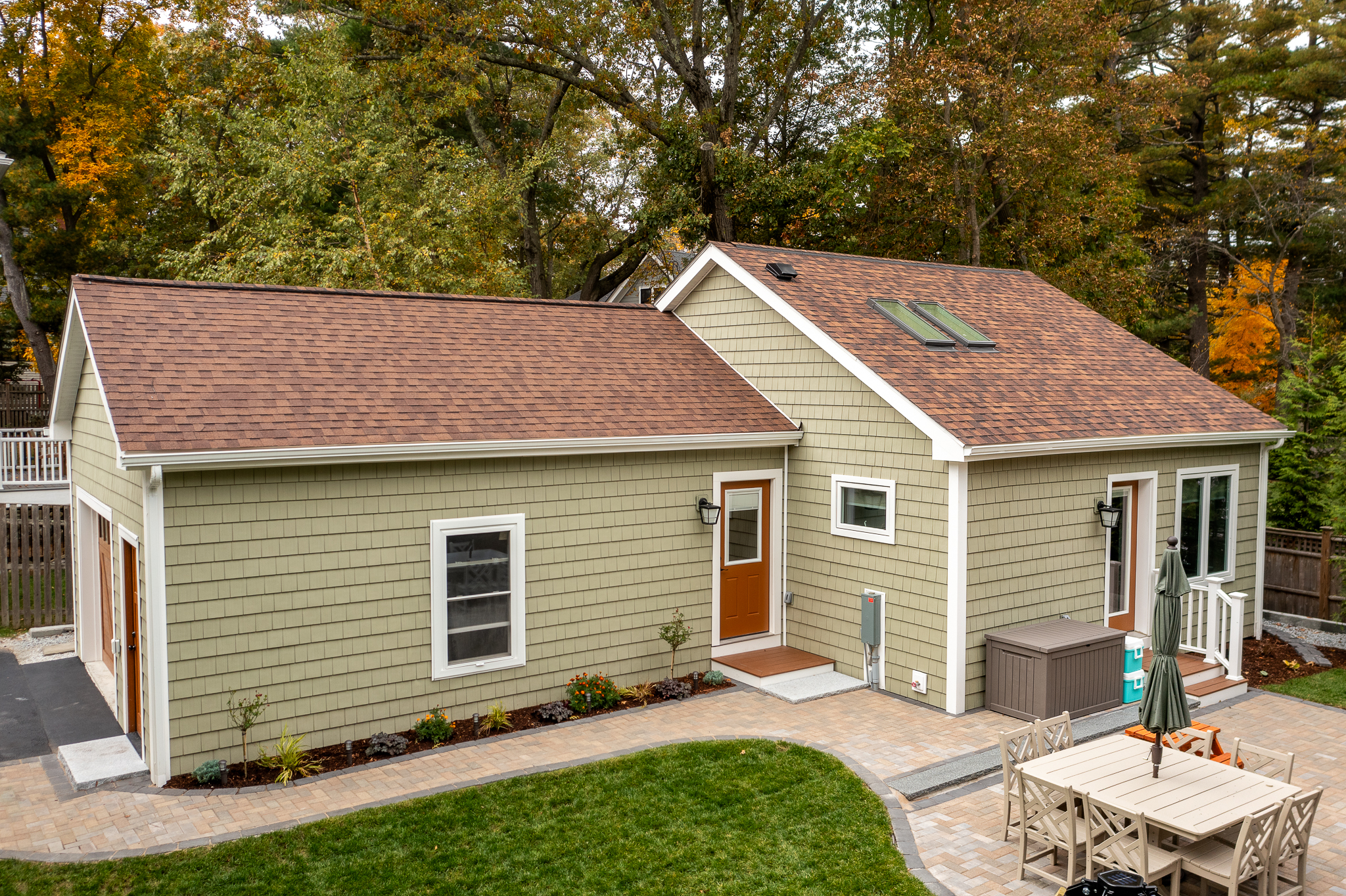
Soft costs related to permitting can add more than $30,000 to the cost of an ADU, according to an executive for design-build firm Backyard ADU’s. Pictured is one of the Brunswick, Maine company’s projects in Arlington. Photo courtesy of Backyard ADUs
Massachusetts lawmakers sought to tap into a neglected source of housing production within arm’s reach by legalizing construction of backyard accessory dwelling units statewide.
Since taking effect in early 2025, the law’s effects have played out unevenly so far, researchers say, reflecting time and money spent cutting through a thicket of regulations that vary in many of the state’s 351 cities and towns.
The result is a lost opportunity for builders, who can’t capitalize on economies of scale because of soft costs related to permitting and design before construction can commence.
“What it means for us on the ground is: we’ve had to fight tooth and nail to build a company that can service the entire state, and it just barely works,” said Chris Lee, head of design and development for Backyard ADUs, a Brunswick, Maine-based design-build firm that’s working on 35 ADU projects in Massachusetts.
Permitting Takes Twice as Long in Mass.
Soft costs for a $275,000 ADU can range from $10,000 in towns with easily navigable permitting, such as Easthampton, to over $30,000 in communities such as Lexington and Newton, Lee said in an interview.
They cover preconstruction project management, civil engineering, surveying and test pits to comply with sanitary and wetlands regulations. Architectural fees are an additional cost, all of which are ultimately passed onto buyers.
“The only way to really deal with it is you need very, very skilled operators on your preconstruction team to work with all of the different towns, so you can get through the permitting,” Lee said during a forum sponsored by The Boston Foundation last week. “You just don’t keep saying ‘yes’ to all of the things that the local municipality is asking you to do, because every time you say yes, it’s more money to the homeowner.”
On average, ADU permitting in Massachusetts takes four to six weeks, twice the timeline in Maine and New Hampshire, Lee said.
Only two Massachusetts communities outside Boston – Plymouth and Lawrence – have permitted more than 30 ADUs since the law took effect in early 2025, according to the most recent data released by the Massachusetts Executive Office of Housing and Livable Communities in February. The statewide total was 1,224.
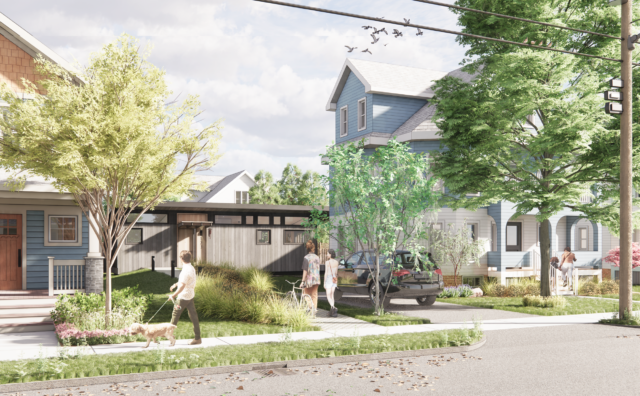
State officials named ICON Architecture’s ADU design the winner of a spring contest. The event generated nearly 100 plans, now free for the public, to try and lower construction costs. Image courtesy of ICON Architecture and the Executive Office of Housing and Livable Communities
The number is higher than would have been approved without the new ADU rules, approved as part of the 2024 Affordable Homes Act, zoning researcher Amy Dain said. But it still represents a tiny uptick in a state of over 7 million residents and over 3 million housing units.
“Our system of local land use regulation undermines economies of scale. This is all a fundamental issue for ADU production, and for production of missing middle housing,” Dain, a senior fellow at The Boston Foundation’s Boston Indicators think-tank, said in a presentation last week.
The high cost of many ADUs prompted MassHousing to allocate a portion of a $20 million state housing bond bill toward ADU construction, Gov. Maura Healey announced in January. The Pioneer Institute has called on state officials to pass additional ADU reforms, such as statewide elimination of parking requirements for ADUs and enabling backyard cottages to be sold separately from the primary residence.
Local Officials Split on ADU Compliance
The law has rekindled similar arguments to those over the MBTA Communities Act and age-old tensions between state and local officials over control of land-use policy.
The law forbids communities from requiring discretionary approvals – such as special permits – for ADUs. Approximately one-third of Bay State communities updated their ADU regulations after it took effect.
“A builder has to learn how this works in Newton, and then can’t apply the knowledge to the next town,” Dain said. “You have a lot of builders who are working in one or two communities, and that’s why we have barriers to these economies of scale.”
Officials in some communities embraced the opportunity to encourage construction of lower-cost dwellings within their borders.
In Braintree, where median single-family home prices averaged $670,000 from January through April, officials went beyond the state law in crafting regulations designed to be ADU-friendly, District 5 City Councilor Meredith Boericke said during last week’s forum.
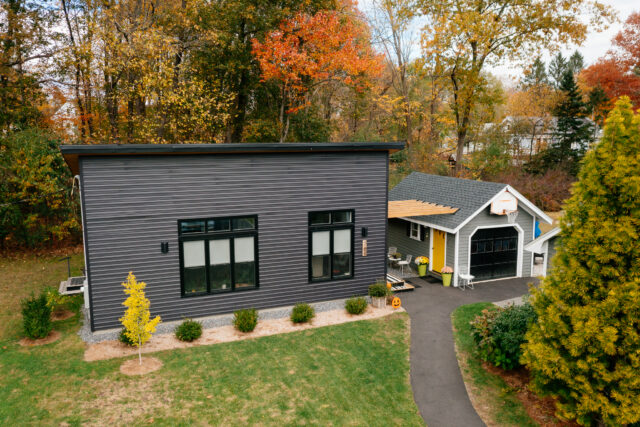
Despite a 2024 state law legalizing ADU’s in residential districts, permitting for such projects takes twice as long in Massachusetts as those in Maine and New Hampshire, according to an active ADU builder. Photo courtesy of Backyard ADUs
Braintree zoning allows ADUs to be built with 5-foot setbacks from property lines. The strategy was designed to make more ADUs feasible in a community where more than a third of house lots are under 10,000 square feet, Boericke said. Braintree has approved 10 ADUs thus far.
The law also has forced local officials to frame land-use debates as a question of how to encourage more housing construction, rather than whether additional development is desirable, said Boericke, who is also ADU program director at the Massachusetts Housing Partnership.
But not all local officials support an easier pathway to ADU construction.
In Woburn, Planning Board members and city councilors clashed over elements of the new ADU bylaws as they were being finalized in spring 2025. Some councilors chafed at the state mandate, decrying it as an abuse of Beacon Hill’s powers to influence local development, and indicated they wanted the town’s zoning to discourage ADU’s.
Since July 2025, Woburn’s building department has issued permits for nine ADUs, only one of which was detached new construction. Two others are currently in the permitting pipeline, one of which would be a new detached structure.
“The law is still relatively new, and two: The sticker shock to build an ADU, in many if not all cases, exceeds $300,000,” Woburn Planning Director John Cashell wrote in an email. “So, it’s quite an investment to undertake.”

Steve Adams
Building and Energy Codes Remain Roadblocks
Regulations approved by state officials in early 2025 set the ground rules for local communities on ADUs.
But a report written by Dain and released last week by Boston Indicators research arm outlines other local regulations that discourage ADU construction or drive up costs.
Under the 2024 law, one ADU up to 900 square feet can be built on a residential lot without a special permit in single-family residential districts, regardless of minimum lot sizes. Municipalities can impose dimensional requirements such as setbacks, height and lot coverage, up to the most permissive standards applying to a principal dwelling.
The new law doesn’t override building codes, an area identified by architects and builders as a barrier of ADU construction and cost driver. Similarly, state energy codes should be updated to include ADU-specific provisions, the Boston Indicators report recommended. And ADU’s should be exempted from local septic system regulations that are more stringent than Title 5, the base statewide code.
“The regulatory changes are going to be tough, because in some cases it means unraveling a system that is deeply entrenched and requires so many different agencies to weigh in,” said Jesse Kanson-Benanav, executive director of Abundant Housing MA. “With a strong governor who is committed to making this happen, Gov. Healey can lean on the various secretariats, but it will take time.”