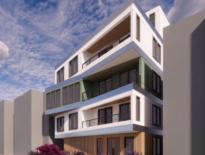
The Kraft Group’s Everett stadium needs to clear permitting hurdles designed to minimize the effects of developments on environmental justice community populations in Massachusetts. Image courtesy of The Kraft Group
The Kraft Group unveiled a redesign for a bridge between Boston and Everett as it seeks approval for a professional soccer stadium on the Mystic River waterfront.
The Alford Street bridge is expected to be a major route for soccer fans and concert-goers taking the MBTA Orange Line to the proposed 750,000 square-foot stadium at the former Mystic Generating Stadium power plant.
Developers hope to complete the stadium in 2029, replacing the New England Revolution’s existing home at Gillette Stadium in Foxborough.
Consultants VHB outlined the preliminary transportation plans Thursday as the Kraft Group prepares to submit an environmental impact report to the Massachusetts Environmental Policy Act office next month.
The stadium will have capacity for up to 35,000 patrons for concerts and 25,000 seats for soccer matches, but the 20-acre site will include only 150 parking spaces.
But since the Orange Line hasn’t stopped in Everett since the 1970s, new infrastructure will be needed to efficiently get them across the Mystic River from the Sullivan Square station.
The MBTA’s Lower Broadway and Alford Street project includes a roadway redesign for the bridge spanning the Mystic River, reducing its vehicle capacity from four lanes to three while adding a separated busway and bicycle lane set to run all the way to Sweetster Circle over Revere Beach Parkway. That busway would host the MBTA’s regular Everett-bound buses for now, but could eventually host an as-yet-unfunded extension of its Silver Line service from Chelsea, Logan Airport and Boston’s Seaport District.
The stadium transportation plan incorporates a “non-automobile last mile strategy,” encouraging stadium visitors to take transit, or drive to off-site parking lots or rideshare drop-off locations, VHB representatives said.
But private vehicles would still account for 40 percent of the stadium trips, according to developers’ presentation, with an additional 15 percent rideshare component.
Water shuttle service also will be a “meaningful access mode,” according to the presentation. Boston Harbor Now has asked developers to partner with the Massachusetts Water Resources Authority on a new ferry terminal at a former sewer pumping station located next to the stadium property.
Specifics on the transportation plan are expected to be included in the upcoming MEPA filing.
Transit and environmental advocates also are asking The Kraft Group to upgrade MBTA bus service and ferries to minimize the number of visitors who rely on vehicles. Boston Chief of Planning Kairos Shen, in a recent comment letter, asked for expansion of MBTA bus operations and more details on how the MBTA Silver Line Extension can be integrated into the stadium transportation puzzle.
During a question-and-answer period Thursday night, Conservation Law Foundation attorney Breanne Frank asked developers for details on reducing urban heat islands.
The project includes a nearly 4-acre park on the riverfront, replacing impervious surfaces.
“We are cognizant of heat impacts and will provide shading focused on that,” VHB Director of Land Development Brittany Gesner said.
CLF also has asked developers to consider all electric building systems. The current proposal would generate approximately 2,500 tons of greenhouse gas emissions per year, according to a MEPA filing.
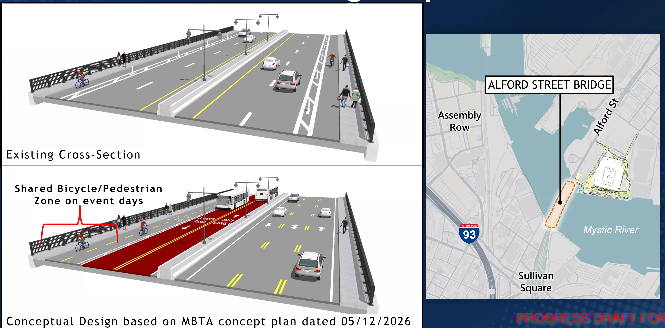
A rendering showing a potential MBTA bus rapid transit corridor on the Alford Street bridge between Everett and Charlestown. Image courtesy of VHB and MBTA
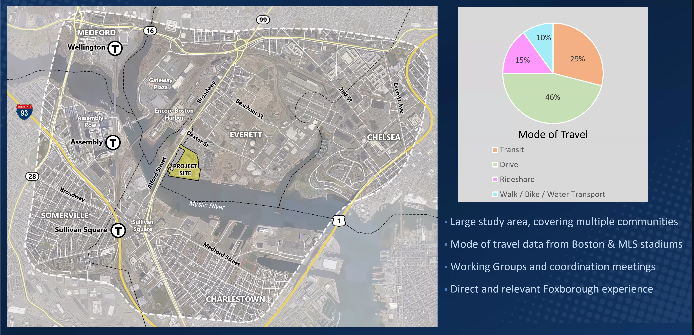
Image courtesy of VHB