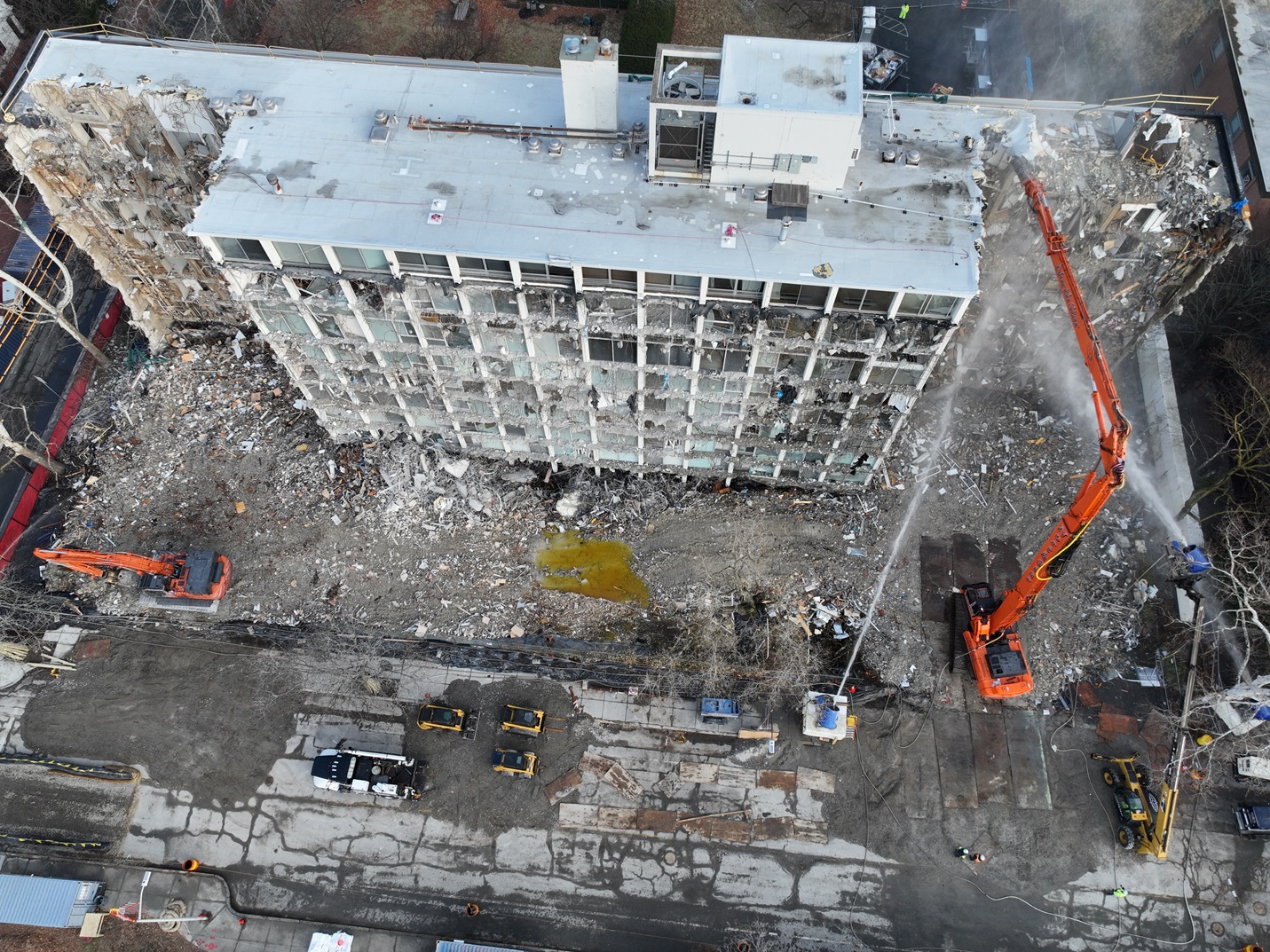
Demolition of the Riverview condominium building in Cambridge began in December, more than a year after engineers discovered structural deficiencies placing the building at risk of collapse. Photo by Consigli Construction | Courtesy of the City of Cambridge
A succession of crisp sunny days signaled peak autumn in New England as residents of the Riverview condominiums in Cambridge prepared for one of the social highlights of the year in mid-October 2024.
Balconies at their 8-story building offered bird’s eye views of the Charles River, where thousands of rowers would be competing in the upcoming weekend’s Head of the Charles regatta. Many residents had invited friends to watch parties in the mid-century Modern structure completed in the early 1960s.
But those parties never took place.
By early 2026, passing motorists and joggers on the Memorial Drive footpath were greeted by the jarring sight of crews from Consigli Construction hammering away at the 66-unit condo building’s concrete walls and floors with heavy-duty demolition equipment amid the snow. Hoses sprayed water to dissipate asbestos and concrete dust, accompanied by the machine-gun cadence of hydraulic breakers.
Now, as trees along Memorial Drive prepare to bud, a Massachusetts Land Court judge is overseeing the future sale of the property.
The 2024 discovery of Riverview’s structural vulnerabilities would force residents to relocate at their own expense, while the city authorized funding for an estimated $8 million demolition project.
“There is no precedent as far as I know in Massachusetts for anything of this magnitude,” said Matthew Gaines, a real estate attorney and partner at Braintree-based Marcus, Errico, Emmer & Brooks.
Discovering a Worst-Case Scenario
The Riverview demolition is an extreme example of the risks that condominium owners and potential buyers face. But real estate attorneys say similar perils await elsewhere as decades-old buildings age and some condo associations skimp on reserve funds for maintenance and repair.
It’s unclear whether trustees at the Cambridge property could have discovered the existential threat to the property earlier, and if the building could have been repaired at a lesser cost.
Engineering studies in 2024 estimated the repair cost at a staggering $73.2 million, or $915,000 per unit. Repairs would require removal of all mechanical equipment, forcing residents to relocate for years. And condominium associations’ master insurance policies typically cover damages to common areas from hazards such as fire and storm damage, but not structural defects.
The 2021 collapse of a 12-story condominium tower in Surfside, Florida, which killed 98 people, has prompted many condo associations to take a closer look at structural integrity of buildings.
Massachusetts’ condominium law, Chapter 183A, doesn’t include particularly stringent requirements for associations to maintain or inspect buildings for defects, real estate attorneys say.
But following the Surfside disaster, government lender Fannie Mae expanded a “blacklist” on many condominium properties that it deemed risky investments due to insufficient insurance or deferred maintenance. Condos on the list, which has not been made public, cannot be sold through conventional loans.
“The ‘green banana syndrome’ is not going to be tolerated anymore in condominiums, i.e. ‘We’re not going to raise fees to fix things because I don’t care what happens to the next generation,’” said Edmund Allcock, managing partner at Braintree-based law firm Allcock Marcus.

A state Land Court judge is overseeing the early stages of a sales process for 221 Mount Auburn Street in Cambridge, following demolition of the Riverview condominium tower. Photo by Consigli Construction | Courtesy of the City of Cambridge
Risks from Compromised Concrete Slabs
According to court documents, Riverview’s fatal flaw stemmed from its original construction in 1963. But it wasn’t until early 2023 that a glaring red flag materialized.
Water was leaking into units on the south side of the tower, prompting condo trustees to begin a roof replacement project on the eighth floor.
During the work, Waltham-based engineers SGH discovered cracks in balconies, and indications that concrete slabs were compromised as well. They determined that rebar had been installed two inches lower within floor slabs than specified in the original 1961 construction drawings, according to a court filing.
The scope widened to a full-scale structural assessment of the building. SGH found widespread structural defects that overloaded concrete slabs by more than 50 percent of their design capacity. Wind, snow and vibration, or even regular use, could trigger a building collapse.
Those 2024 Head of the Charles watch parties, with their additional stress on the building, would be cancelled. Trustees and engineers discussed how to protect Riverview from the weight of snow as winter approached. Ultimately, they decided to evacuate the building. The last resident moved out on Christmas Eve of 2024.
Faced with a $73.2 million repair bill, a majority of residents voted against the repair project. While trustees were debating whether to demolish the building and how to pay for it, the city of Cambridge’s inspectional services department condemned the building in June 2025 and received Middlesex Superior Court authorization for demolition. A lien was placed on the property for the costs, estimated by Consigli Construction at $8.8 million.
Last week, the city of Cambridge submitted a filing to state Land Court to recover “all costs associated with demolition” of Riverview, including police details, environmental contracts and attorney’s fees.
“It’s just unbelievable this all came down to a design or construction defect and it wasn’t built in accordance to the plans. The fact that it took 40 or 50 years to manifest itself, having any recourse against those [developers and contractors] seems unlikely,” Gaines said.
Partition Process Clears Way for Sale
The financial stakes for Riverview owners hinge partially on an upcoming sale of the property, being overseen in Land Court.
Real estate records indicate some long-time owners paid as little as $162,000 for their units in the 1990s. A three-bedroom condo sold for nearly $3.4 million in 2023.

Steve Adams
Riverview owners voted to terminate their individual ownership through a partition process under Massachusetts law: a legal avenue requiring 75 percent of owners to agree not to repair, if estimated repair costs exceed 10 percent of the aggregate value of the condominium.
In March, Land Court Judge Diane Rubin appointed attorney Christopher J. Sullivan of Quincy as commissioner to determine the value of the property and prepare a marketing and sale process.
In an interim report filed April 7, Sullivan stated he has had discussions with Mahmood Malihi, co-president of Boston-based Leggat McCall Properties, on acting as real estate advisor on the sale.
“There is a possibility that certain unit owners will not receive any sale proceeds after their mortgages, real estate taxes and outstanding condo fees, where applicable, are paid,” Sullivan wrote.
Potential condominium buyers should beware of warning signs that indicate a property may need expensive repairs, condominium attorneys say. Regular inspections of common areas are critical, said Samantha McDonald, an attorney at Bowditch & Dewey in Boston. Maintaining at least three months reserves of operating expenses as a cushion is a standard guideline.
“A reserve might not have helped in this situation, but there are plenty of associations where it might have,” McDonald said. “Especially in the smaller associations, that is something that should be observed.”