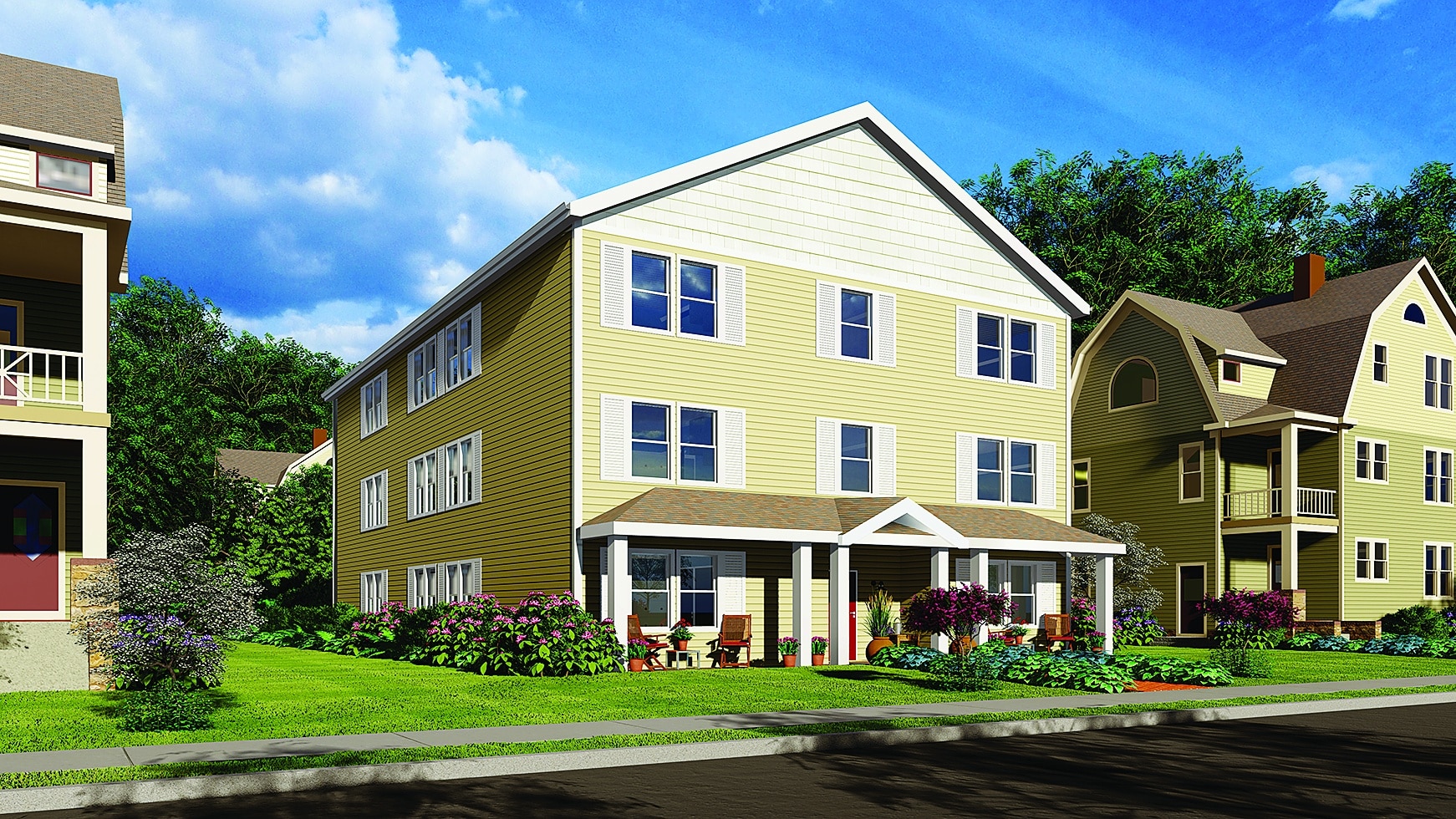
Modular housing can fit on vacant lots in urban areas and provide social service agencies with the opportunity to create low-cost permanent housing for previously homeless individuals. Image courtesy of Margulies Perruzzi
The leader of a Boston-based nonprofit envisions modular-built projects as a potential solution to the missing middle housing shortage, but there’s a catch: it will require a local landowner to provide a half-acre site at low cost to make the numbers work.
“We’re all ready to go. We just can’t find a parcel of land,” Heading Home CEO Danielle Ferrier said. “Half an acre in the eastern part of the state shouldn’t be that hard to find, but it is a little more complex than people realize.”
The pilot project would create eight to 12 apartments in partnership with Worcester-based Integrity Modular Design & Construction.
Heading Home’s goal is to offer the apartments to households earning 50 to 80 percent of area median income, with rents ranging from $1,500 to $2,200 per month. It estimates project costs at $270,000 per unit, not including land acquisition.
With its fast-track construction schedules, modular housing has the potential to increase housing stock without relying upon the complex and lengthy assemblage of subsidized financing packages typical for income-restricted developments, Ferrier said.
The sticking points, under Heading Home’s business plan: finding a suitable parcel that’s zoned by right for multifamily housing, and finding a seller willing to part with the site for approximately $50,000 per unit.
A trip to Toronto, which is subsidizing modular housing on infill development sites for formerly homeless individuals, prompted Ferrier to put out the call for a similar site in Greater Boston.
Because of the resistance to multifamily development in many suburbs, and desire to move quickly on the project, the organization is looking for a site that’s zoned by right for multifamily housing.
“We’re not looking to fight with folks,” Ferrier said. “Any town should want to put this type of housing in their community for their teachers, their police department and their firefighters. That intention is there, but it’s what happens when the rubber meets the road. We’re looking for a community that wants to partner with us.”
The organization also is seeking donors to help offset the cost.
Heading Home owns and operates shelters, supportive housing facilities and rental properties for approximately 800 clients.
Its most recent ground-up development, 20 units of supportive housing at 37 Wales St. in Dorchester, began formal permitting in 2020 and opened in 2025.
The lengthy timeline prompted Ferrier to approach Heading Home’s board of directors and pitch a modular approach for its next project. She presented a financial plan that indicated the project could be viable without the typical subsidies required for income-restricted projects.
“If my assumptions are correct, the model can be replicated by other nonprofits across the country,” Ferrier said.
Modular construction’s time and cost savings is being tested in Taunton by Greystar, the nation’s largest apartment landlord, which is demolishing a vacant mill to assemble 390 apartments shipped from a Pennsylvania factory.
MassDevelopment is using modular construction for its next housing project at Devens. In February, the state agency sold a 2-acre parcel at 25 Adams Circle for $600,000 to Reframe Systems for a project including 12 duplexes assembled at Reframe’s Andover factory.