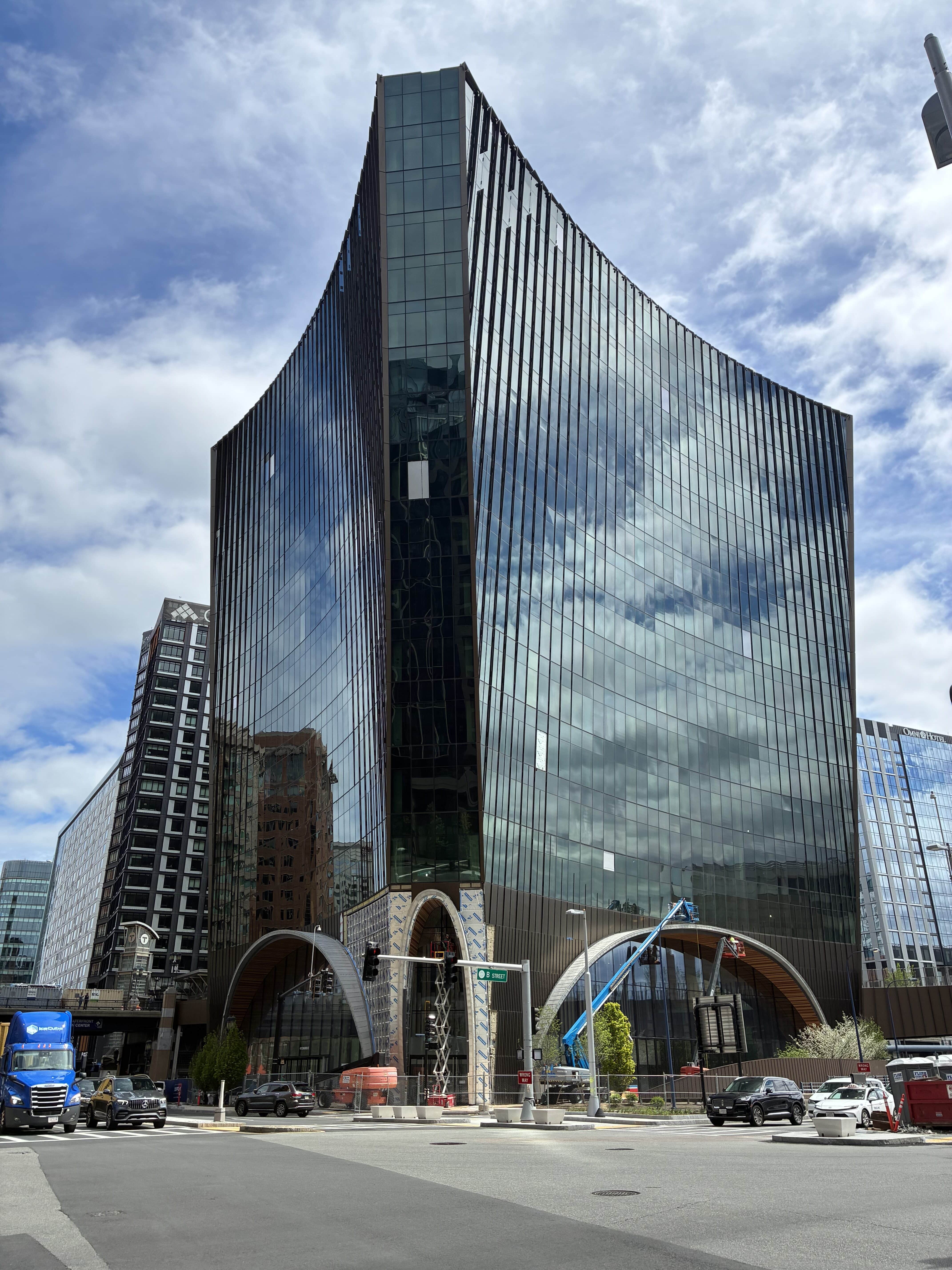
Lab tenants largely gravitated to Cambridge and western suburbs while bypassing new developments in Boston such as Boston Global Investors’ 10 World Trade. Photo by Steve Adams |Banker & Tradesman Staff / File
Shifting market conditions sorted out winners and losers in the office and lab markets, lenders moved to cut their losses on distressed properties and multifamily housing approached the end of a busy construction era in 2025.
Beyond the headlines, several trends left their mark on local real estate, pointing to conditions to watch in the coming year.
1) Seaport District Lab Market Sputters
Many neighborhoods have laid claim to the mantle of “the next Kendall Square” during the life industry’s rapid expansion of the past decade, but perhaps no name has been bandied about more than Boston’s Seaport District. But the lab market hasn’t played out as smoothly as the Seaport’s previous waves of office and housing development.
The 6.6 million square-foot Seaport District lab submarket had a 31.4 percent vacancy rate at the end of the third quarter, according to data from Hunneman.
Eli Lilly & Co.’s 75,000 square-foot expansion at Oxford Properties Group’s 645 Summer St. was the largest lab lease signed in 2025. Previously, the Seaport District lab submarket had less than 32,000 square feet of absorption in 2025, according to CBRE data. Boston Global Investors delivered its 570,515 square-foot 10 World Trade tower at midyear without any tenants.
Across the river in Cambridge, Kendall Square’s 17.8 million square-foot lab market solidified its position as the industry epicenter. Biogen signed a 580,000 square-foot lease to relocate its headquarters to the first building at MIT’s Kendall Square development. West Cambridge also added a well-capitalized startup with Lila Sciences’ 246,500 square-foot lease at IQHQ’s 1 and 5 Alewife Park.
Meanwhile, the suburban lab submarket had over 250,000 square feet of positive absorption in the third quarter alone, with Watertown adding 150,000 square feet of occupancy. While suburban lab vacancies remain elevated at nearly 33 percent, recent leasing activity points to a preference for Cambridge and western suburban markets, which have been linked to the industry’s workforce and commuting patterns.
2) Lodging Industry Braces for a Busy 2026
Boston has become one of the most expensive places on the planet to rent a hotel room, even before major events in 2026 are expected to attract hundreds of thousands of visitors to Massachusetts.
One online survey recently ranked Boston as the world’s most expensive hotel market, surpassing New York City and Zurich.
Some hotels have been converted into alternate uses, such as Northeastern University dorm rooms and affordable housing. And new hotel supply that could ease the lodging crunch has been slow to materialize. Two exceptions: a 240-room hotel opened in early fall at the Harvard Enterprise Research Campus in Allston, and NB Development’s groundbreaking on a 170-room hotel at 180 Guest St. in Brighton.
Demand for hotel rooms is expected to spike in mid-2026, with seven FIFA World Cup matches scheduled at Gillette Stadium and hundreds of events commemorating the 250th anniversary of the American Revolution. Another beneficiary could be owners of short-term rental properties, who are already under scrutiny by the Boston City Council for perceived abuse of the city’s regulations.
3) Home Rule Can Work in Favor of Housing, Too
Resistance to the MBTA Communities law made headlines, including legal challenges by some communities to the multifamily rezoning requirement.
But it turns out that home-grown policies to encourage housing growth can gain momentum, as a regional YIMBY network has taken an active role in local elections.
Some communities opted to chart their own land-use destiny, in planning processes that proceeded parallel to MBTA Communities compliance.
Burlington rezoned 117 acres along Mall Road to accommodate up to 750 housing units and nearly 500,000 square feet of commercial development. Salem eliminated minimum parking requirements for all multifamily developments with three or more units.
Following the Cambridge City Council’s landmark abolition of single-family zoning in February, Medford officials debated a citywide rezoning proposal creating four new districts in which multifamily housing would be allowed by-right. The city also added multifamily housing to allowed uses along two commercial corridors: Mystic Avenue and Salem Street. Debate on the neighborhood rezoning is scheduled to resume in the new year.