
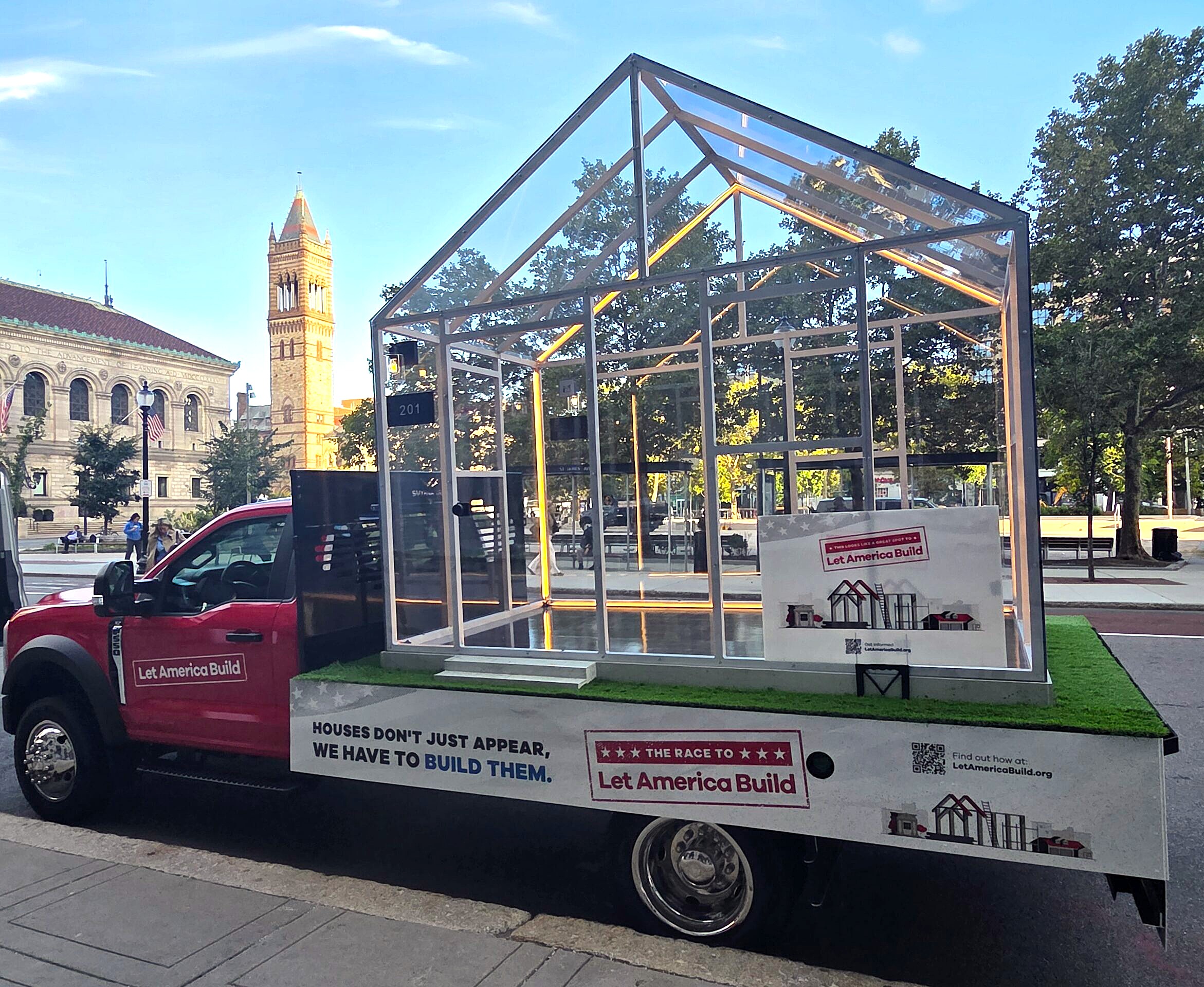
Photo by Sam Lattof | Banker & Tradesman Staff
If you saw a glass house driving around Boston, it was not advertising the latest trend in architectural design.
Instead, it’s here because a coalition of real estate trade groups, housing groups and big corporate names kicked off their “Let America Build” campaign in the Back Bay Wednesday morning. The aim is to get people talking about ways to build more homes in Massachusetts and across the country in advance of this fall’s elections.
The national public awareness campaign is focused on the need to increase housing supply for Americans. Along with listings portals Realtor.com and Zillow, the National Association of Realtors, brokerage consultancy T3 Sixty, the National Association of Home Builders, Habitat for Humanity and Land Use Labs are working together as part of the campaign.
“I think we’ve put together a wide coalition of partners here, and even some that we’re in direct competition with,” Realtor.com Senior Economist Joel Berner said in a media briefing in Boston’s Back Bay neighborhood Wednesday. “We’ve got Zillow on board with Realtor.com here to really draw this issue into the limelight. It’s not about who’s winning and who’s losing or who’s making money and who’s not. It’s really an industry-wide effort, a rising tide to lift all boats, because housing is important not only for people who are in the housing industry. It’s important for people to have places to live. It’s important for industries that are adjacent to housing. Your home improvement stores and your furniture stores would certainly benefit from more people being able to move into their own homes.”
Realtor.com research has shown that there is a 4.03 million-unit housing supply gap in the United States. In Massachusetts, Healey administration housing officials estimate the state needs to build 220,000 units between 2025 and 2035 just to keep pace with demand.
In the current market, even when new homes are being put on the market, they are largely unaffordable. The median price of a single-family home in the Boston metro is currently $795,000, according to Realtor.com.
“Even when new homes are being delivered, they’re often not being delivered at a competitive price point,” Berner said. “So that’s really what we’re talking about here: doing everything we can to empower local governments to facilitate more home building, helping them to kind of get out of their own way in terms of long permitting timelines and really restrictive zoning laws. We want to make housing a central piece of what people are thinking about as they go to the polls this November, and we want to hold local leaders accountable to deliver more housing because if we’re going to be able to house the people of this country, we need more homes to be able to do it. The only long-term solution to the housing shortage is to build more homes.”
Massachusetts’ highest-profile effort to spur housing production to date – the MBTA Communities Act that requires towns to set up modest transit-oriented zoning districts – created such a furor that Republican gubernatorial candidate Mike Minogue has made opposition to it a central part of his platform, although the law was passed and implementation began under Democratic Gov. Maura Healey’s Republican predecessor, Charlie Baker. Minogue’s campaign website includes a pledge to “eliminate the enforcement of the MBTA Communities Act and provide legal support to cities and towns that do not accept the terms because of their limitations with water, sewer, infrastructure, and school resources. Doing this will empower towns to have the ultimate responsibility and decision-making to maintain the function and culture of their communities.”
Meanwhile, Healey’s campaign is putting her housing production efforts in the spotlight, from highlighting the number of homes produced by her proposal to legalize accessory dwelling units statewide to endorsing a ballot question that would legalize small-lot single-family houses everywhere in the state with municipal water and sewer service.
Fixing America’s housing problems needs bipartisan support and a collaborative approach, according to Berner.
“I think it is a bipartisan issue,” he said. “It’s really about being able to house the people of this country, and preventing and retroactively fixing the decades of underbuilding that have happened throughout this country. So I think elected leaders of both parties need to be held to account about this. It’s really not so much a red versus blue thing. It’s a yes, we can build these homes versus not in my backyard, people kind of thing. I think there are people of both parties who fall into that NIMBY category. The tide seems to be turning in favor of those who want to build in terms of pro-housing policy versus the kind of protective policies that the NIMBY movement has held onto for a really long time.”