iStock photo illustration
When you checked out for the summer after Memorial Day, the Massachusetts real estate world didn’t stop turning.
Buildings were bought and sold, political battles were fought, leases were signed, and at least one high-profile development proposal collapsed.
Here are the five biggest stories you missed between summer camps, barbecues and vacations.
Rent Control Goes Down on a Technicality
This spring, it seemed like Massachusetts was barrelling headlong towards a future of rent control and resulting huge upheaval in the commercial real estate industry.
Polling suggested voters were predisposed to back a draconian ballot question in the November elections, and multifamily investors and developers were full of talk about abandoning Massachusetts, or even bank failures.
In what amounted to a desperate, Hail Mary pass, a small group of affordable and market-rate developers broke ranks with industry trade groups and their peers in early June to negotiate a compromise with the coalition of labor unions and tenant groups behind rent control. The deal would have set a theoretically more manageable cap of 5 percent on all annual rent increases, plus the rate of inflation, and would have turned rent control from a statewide mandate into a thing individual towns and cities could opt into while also banning evictions for all but a narrow list of exceptions like non-payment of rent or lease violations.
The proposal, naturally, went over like a lead balloon with trade groups and the state legislators who would have had to pass it.
Then, out of the blue, the state Supreme Judicial Court handed real estate forces a win by disqualifying the ballot measure on a technicality after a lawsuit brought by trade groups pointed out it would regulate religiously-owned housing, something that’s against the state constitution.
The ruling in late June isn’t the end of the story, though. Angry rent control backers declared their intent to return to the ballot box in 2028, giving the real estate industry and their Beacon Hill allies a scant two years to put reforms in place that might take some of the wind out of rent control’s sails.
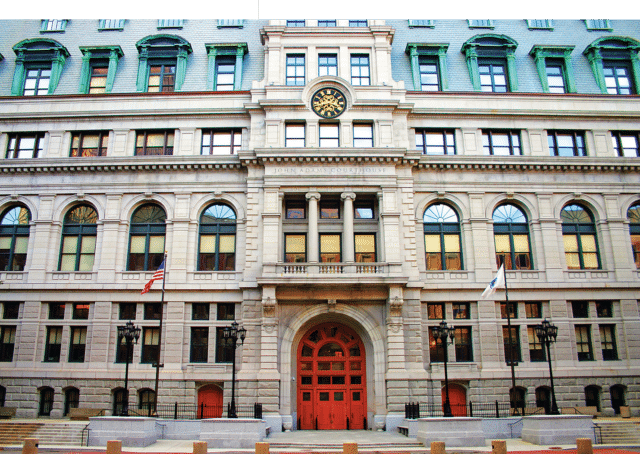
The John Adams Courthouse, seat of the Massachusetts Supreme Judicial Court. iStock photo
A Tale of Two Somerville Towers
Two towers on either end of Somerville – one built but empty, the other merely proposed – show where two cornerstones of the local real estate industry are right now.
First, national developer Greystar appears to be shifting strategies to fill its 74M tower in Assembly Square.
Construction on the life sciences tower began in 2022 without any tenants lined up amid a historic expansion in the local and national biotech industries. The tower delivered in 2024 still missing any tenants after that boom turned into a bust, leaving Greystar and lab landlords across the region high and dry.
B&T confirmed last month, via brokerage sources, that Greystar shifted gears to sign a lease with Mass General Brigham for a substantial portion of the tower. The hospital chain, which is headquartered nearby, would use the space for offices and potentially some clinical space, our sources told us.
Local brokerages are tracking up to 16.6 million square feet of vacant lab space across the Greater Boston region, while CBRE is tracking just 2.45 million square feet of lab space requirements despite an uptick in venture capital funding for local firms. So more pivots like this could be in store.
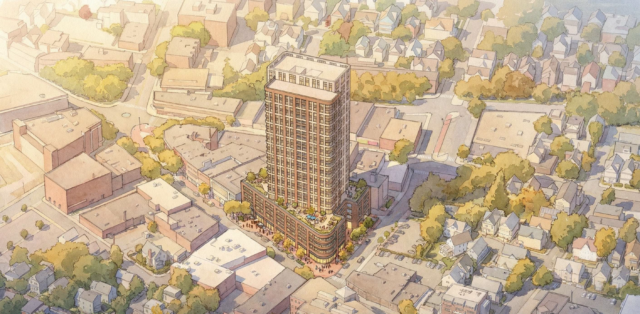
One of three possible designs developer Copper Mill has told residents it could use for its planned residential tower in Davis Square. Image courtesy of CBT Architects
Meanwhile, on the other side of Somerville in Davis Square, developer Copper Mill announced last week that it’s pulling the plug on a highly anticipated, but never permitted, apartment tower nearly on top of the local MBTA Red Line station. In the background: contentious discussions with neighborhood residents over the building’s height and unit count, which Flynn said was necessary to meet Somerville’s requirement to put income restrictions on 20 percent of units in all new multifamily buildings. Incidentally, that requirement and contentious politics around upzoning have been blamed for Somerville’s low rate of housing production in the last decade.
Copper Mill owner Andrew Flynn and city Mayor Jake Wilson traded barbs over who was to blame for losing what could have been around 500 new homes – 126 of which would be income-restricted – on top of a subway line. Flynn faulted city officials for providing misleading and contradictory direction. Wilson called the claims “in a word, laughable,” saying “anyone who works with us knows we are serious about working with developers in our city,” citing tax breaks given to fill a different vacant lab building in Assembly Square and recently restarted a neighborhood planning study in Davis Square.
In addition to tensions over the Davis Square tower’s height and unit count, Flynn had drawn fire from residents and elected officials over a lawsuit filed against Copper Mill accusing the firm of defrauding the former owners of a Cape Cod inn. Flynn contested the lawsuit’s allegations in a court filing late last month.
Power Struggle Roils Major Brokerage
This summer saw a high-stakes battle among top office brokers at Newmark break out into the open.
Edward Maher Jr. and Matt Pullen, who specialize in marketing and coordinating the sales of skyscrapers and other high-profile office assets, sued the longtime leader of Newmark’s Boston-based capital markets team, Robert Griffin Jr. At issue? “[A] sustained campaign of exclusion of Mr. Maher and Mr. Pullen from important business and client matters,” their lawsuit stated.
The duo said they were frozen out of major deals, and then quit after one allegedly discovered Griffin and the rest of the Newmark capital markets team had supposedly told a client he was leading the effort to sell the client’s building, when he only found out about it the day of the pitch meeting.
The lawsuit is still ongoing.

Edward Maher Jr. (left) and Matt Pullen. Photos courtesy of Newmark / File
Housing Market Softens as Rates Stay High
Did you ever think the balance of power between homebuyers and sellers might approach something like parity in Greater Boston, ever? Data that came in over the summer suggests that happened this spring.
As B&T reported in August, the spring home-sales market started sluggish. Real estate brokers, agents and economists we talked to said it seemed to be caused by two things: a harsh end to the winter that kept folks from coming to market, and worries about the global economy during the first months of the Iran war caused many to put home-search plans on hold. The latter shoved mortgage rates and gas prices – one of the indicators many Americans rely on to measure the economy’s health – upward.
But nothing lasts forever in the market, and by summer a key measure of buyer power, price cuts, was falling dramatically. That might also reflect more accurate pricing this year, but either way, the spread between how many homes had been sold in Massachusetts, year-to-date, steadily shrank all summer, suggesting buyers had returned to the fold and deals were getting done.
And either way, nothing seems to be fixing the affordability problem. An aspiring homebuyer in the Boston metro needed to make $216,995 to afford the median-priced home in Greater Boston in June, according to a report from Redfin this summer. The average interest rate on a 30-year, fixed-rate loan sits at 6.71 percent, according to mortgage-buyer Freddie Mac.
Groundwork Laid for Big Suburban Projects
While the landscape today may seem gloomy to anyone hoping for more housing production to help curb the state’s dire affordability problem, that doesn’t mean developers didn’t spend the summer laying the groundwork for big, future developments.
Look first to Waltham, where office giant BXP convinced city councilors to first back, then override a partial mayoral veto of an upzoning package that will allow up to 2,000 apartments to spring up at three underperforming office parks BXP owns in whole or in part along Route 128, one of which twin with a planned Weston development and could be served by a proposed MBTA commuter rail station.
The company then dropped $30 million late last month on a pair of office buildings it didn’t own, but which had been included in the upzoning.
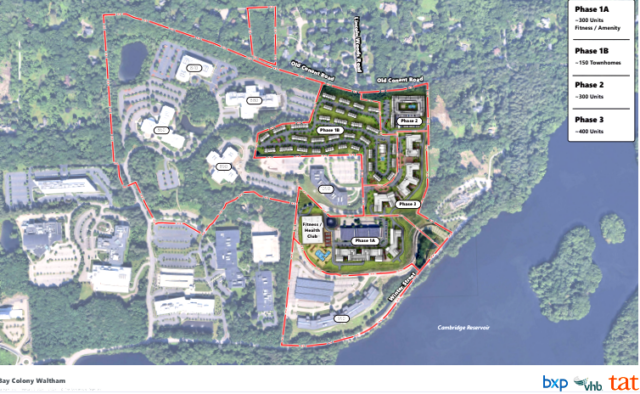
A conceptual master plan for Waltham’s Bay Colony office par. Image by The Architectural Team | Courtesy of BXP
Meanwhile, New England Development and Brookfield Properties were finally able to sort out site control for the former South Weymouth Naval Air Station property after the prior master developer went belly-up.
The current developers are planning 6,500 homes and 2 million square feet of commercial space on the over 1,400-acre site, but must wait for big, new water and sewer infrastructure to be hooked up to the site later this decade.
As if to prove that it’s not just the suburbs that are worthy of investment, New York-based Vanbarton Group filed a proposal with Boston officials to convert a large, prewar Back Bay office building into 490 apartments, nearly double the 255-unit count at the previous record-holder for Boston office conversion proposals.
If there’s one black spot in this picture, it’s the town of Wellesley’s decision to sue to block the state’s move to offer a surplus parking lot at MassBay Community College up for a 180-unit housing development. The move in June was decried at the time as pure NIMBYism by one of the state’s wealthiest communities, while local residents and officials said it was an effort to protect nearby woodlands and the future of the college.